Livrare gratuită pentru comenzile de peste 349 LEI prin Easybox, FAN BOX și Coletăria.

Faceți parte dintr-o comunitate de iubitori de cărți din întreaga lume și beneficiați de o mulțime de avantaje
Creați-vă un cont gratuit
Transport gratuit la punctele de livrare Pick Up peste 349.00 lei
Packeta 15.00 lei
Serviciul de curierat Cargus 28.00 lei
Easybox 20.00 lei
Punct FAN 16.00 lei
Punct DPD 17.00 lei
Curier DPD 25.00 lei
FAN Courier 25.00 lei
 Contact
 Cum să cumpăr
Ajutor
Livrare
Packeta 15.00 lei
Serviciul de curierat Cargus 28.00 lei
Easybox 20.00 lei
Punct FAN 16.00 lei
Punct DPD 17.00 lei
Curier DPD 25.00 lei
FAN Courier 25.00 lei
Transport gratuit la punctele de livrare Pick Up peste 349.00 lei
Consilier de cumpărături
Suntem aici pentru tine!
031 22 95 182
Contul meu
▸
Gol :-(
0
Livrare gratuită pentru comenzile de peste 349 LEI prin Easybox, FAN BOX și Coletăria.
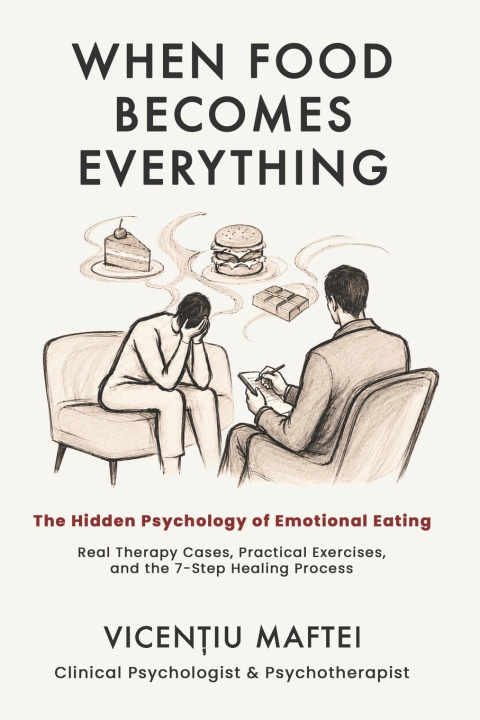
WHEN FOOD BECOMES EVERYTHING
The Hidden Psychology of Emotional Eating, Real Therapy Cases, Practical Exercises, and the 7-Step Healing Process
Limba
 engleză
engleză
Carte
Carte broșată
This is not another diet book. It's therapy in a book - structured the way therapy actually unfolds....
Descrierea completă
Codul Libristo: 53881265
?
 46 b
46 b
 Curând
 Nou
Nou
46 b
Curând
Nou
98.92
lei
Așteptăm intrarea în stoc
Ediția 17. 09. 2026
Până la 30 de zile pentru returnare

This is not another diet book. It's therapy in a book - structured the way therapy actually unfolds.
I'm a clinical psychologist, and after twenty years of working with people who struggle with emotional eating and their weight, I can tell you this: nobody eats at midnight because they don't know what a vegetable is. Most of them know the basics perfectly well. The knowing was never where it broke down. It breaks down somewhere else entirely: in the emotions, the patterns, the stories they tell themselves.Some of them call it emotional eating. Others recognize themselves in binge eating, compulsive eating, or what feels very much like food addiction. The name matters less than what sits underneath it - and that's where this book goes.
We start by looking carefully at your relationship with food: where it came from, how it formed, what it does for you now. Then we go underneath, to what food has been doing for you all along - the emotional hunger, the unmet needs, the pain it has been quietly managing.
And then we work.
More than 30 exercises taken directly from my practice. Over 200 questions designed to reach what usually stays outside awareness. Most of them you answer right there, on the page. This is a book meant to be filled in, not just read - by the end, it will have your handwriting in it.
At the center of it all is Laura. A successful woman who looked like she had everything under control - and who once described food to me as "my suffering partner." Her story runs through the entire book, session by session, so you're never alone with theory. You'll see what this work looks like with a real person: not just the breakthroughs, but the hard parts and the times she slipped back.
Alongside her, you'll sit in on sessions with others - among them Andrew, a successful doctor who worked constantly, until the day he realized food had quietly become the only pleasure left in his life. And Elena, who sabotaged every weight loss attempt for ten years, until she understood: her weight was armor. And a part of her was terrified to take it off.
Because here is what twenty years of practice have taught me: people don't struggle with their weight because of food. They struggle because of a deeper, quieter unhappiness - a life that has become too small, too lonely, too disconnected to bear without some form of relief.
Food didn't cause that. Food was the thing that made it survivable.
As one client put it: "When my stomach hurts, my heart doesn't."
That unhappiness almost always has something to do with relationships - the fear of being abandoned, the fear of depending on anyone. Which is how food became the one relationship that never disappoints. It doesn't leave, it doesn't judge, and it never asks for anything back.
From there, the questions turn toward you:
· What is food actually doing for you - comfort, company, rebellion, protection?
· Why does your self-sabotage arrive right on schedule, precisely when things start going well?
· Whose voice is really speaking when you look in the mirror and hate what you see?
· And the question underneath all the others: what are you really hungry for?
You won't answer these alone. Each one comes with the tools I use in my practice - the dialogue with the part of you that sabotages, the hidden payoffs inventory, the mirror work, the letter to the one you left behind.
One last thing. If you've spent years at war with food, losing the same battle again and again, consider that a diet is never just a diet. Sometimes it's a fight you started long ago, with someone who isn't even in the room anymore. And it doesn't end when you finally get the body you wanted.
It ends when you stop fighting.
Real cases. Real dialogues. Real exercises. Real change.
This is therapy in a book.
Actriță
&
Poliglotă
EWA KASP
pentru
Redă videoclipul


Libristo are cea mai mare selecție de literatură în limbi străine. De aceea îmi cumpăr cărțile de aici.
Informații despre carte
Titlu complet
WHEN FOOD BECOMES EVERYTHING
Autor
Vicentiu Maftei
Limba
engleză
engleză
Legare
Carte - Carte broșată
Data publicării
2026
Număr pagini
300
EAN
9798173403988
Codul Libristo
53881265
Editura
Independently published
Greutatea
406
Dimensiuni
152 x 229 x 17

Dăruiește această carte chiar astăzi
Este foarte ușor
1 Adaugă cartea în coș și selectează Livrează ca un cadou 2 Îți vom trimite un voucher în schimb 3 Cartea va ajunge direct la adresa destinatarului
Consilier de cărți Libroamiko
Prin utilizarea acestui chat, comunicați cu inteligența artificială generativă. Prin utilizarea acestuia, sunteți de asemenea de acord cu prelucrarea datelor cu caracter personal.
Bună ziua! Sunt Libroamiko, consilierul dumneavoastră de cărți.
Cu ce vă pot ajuta?
Bună ziua, sunt Libroamiko, vă pot ajuta?