
 Contact
 Cum să cumpăr

Livrare
Consilier de cumpărături
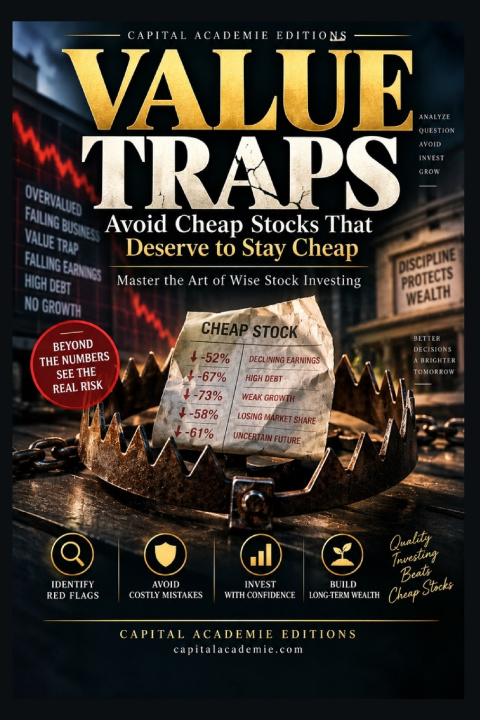
VALUE TRAPS
AVOID CHEAP STOCKS THAT DESERVE TO STAY CHEAP: Master the Art of Wise Stock Investing
 engleză
 27 b
 Nou
Până la 30 de zile pentru returnare

A cheap stock is not always a bargain.
Sometimes, a low valuation is an opportunity. Other times, it is a warning.
Value Traps: Avoid Cheap Stocks That Deserve to Stay Cheap is a practical guide for investors who want to distinguish genuinely undervalued companies from businesses that look inexpensive because their fundamentals are deteriorating.
This book goes beyond the simplistic idea of "buy low." It teaches you how to identify the difference between temporary market pessimism and permanent business weakness-before a seemingly attractive stock destroys capital.
You will learn how to:
• Distinguish true value investments from dangerous value traps
• Estimate intrinsic value and understand the importance of a margin of safety
• Analyze P/E ratios, debt-to-equity, free cash flow, profitability, and earnings quality
• Detect declining margins, weak liquidity, excessive debt, and deteriorating cash flow
• Recognize when low valuation multiples are justified by structural problems
• Evaluate balance sheets, income statements, and cash flow statements with an investor's mindset
• Understand psychological biases such as anchoring, loss aversion, herd behavior, and price relativity
• Avoid emotional decisions driven by fear, greed, or the illusion of a bargain
• Analyze sector trends and determine whether an industry is growing, maturing, or declining
• Understand how economic cycles, inflation, interest rates, regulation, and innovation affect industries
• Evaluate corporate leadership, governance, transparency, capital allocation, and strategic vision
• Identify warning signs in executive incentives and management behavior
• Assess competitive advantage using market share, barriers to entry, brand strength, network effects, and pricing power
• Apply Porter's Five Forces and SWOT analysis to understand competitive positioning
• Evaluate innovation, R&D, technological disruption, and business adaptability
• Analyze customer loyalty, supply-chain resilience, strategic alliances, and globalization risk
• Examine realistic growth prospects instead of relying on optimistic projections
• Build diversified portfolios with stronger risk controls and disciplined monitoring
• Use stop-losses, asset allocation, hedging, and rebalancing as part of a broader investment framework
The central lesson of this book is simple:
Low price does not create value. Strong fundamentals, sustainable cash flow, intelligent management, competitive advantage, and realistic growth do.
A stock can trade at a low P/E ratio because the market is temporarily pessimistic-or because the company is losing relevance, drowning in debt, suffering from weak leadership, or operating in a declining industry.
This guide teaches you how to tell the difference.
You will study how companies such as Kodak, Sears, Blockbuster, BlackBerry, and General Electric became cautionary examples for investors who mistook past strength and low valuations for future opportunity.
You will also learn how to evaluate companies that possess durable competitive moats, adaptable leadership, efficient capital allocation, strong brands, healthy balance sheets, and sustainable growth potential.
Advanced sections explore sector rotation, competitive dynamics, regulatory change, technological disruption, ROIC, intangible assets, management effectiveness, supply-chain risk, valuation multiples, market sentiment, and portfolio construction.
A structured 30-Day Action Plan helps you turn the concepts into a disciplined stock-selection process.
Stop buying stocks simply because they look cheap. Learn how to identify hidden weaknesses, avoid permanent capital losses, recognize genuine value, and build a stronger long-term investment portfolio.


Informații despre carte
engleză

Dăruiește această carte chiar astăzi
Este foarte ușor
1 Adaugă cartea în coș și selectează Livrează ca un cadou 2 Îți vom trimite un voucher în schimb 3 Cartea va ajunge direct la adresa destinataruluiBună ziua! Sunt Libroamiko, consilierul dumneavoastră de cărți.
Cu ce vă pot ajuta?