
 Contact
 Cum să cumpăr

Livrare
Consilier de cumpărături
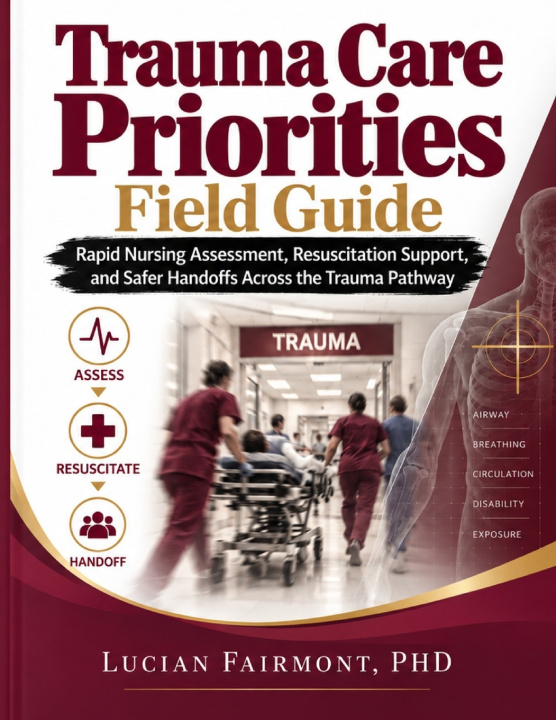
Trauma Care Priorities Field Guide
Rapid Nursing Assessment, Resuscitation Support, and Safer Handoffs Across the Trauma Pathway
 engleză
 356 b
 Nou
Până la 30 de zile pentru returnare

Carry the Priorities Beyond the Trauma Bay
Trauma care does not end when the primary survey is complete. The patient moves to imaging, an operating room, critical care, another hospital, or another team, and the unfinished questions, running clocks, interventions, and risks have to move with them. Trauma Care Priorities Field Guide is an operational nursing reference built around that full pathway, from pre-arrival preparation through resuscitation, transfer, handoff, documentation, and review.
Know What to Watch, Record, and Say
The guide organizes trauma nursing around three jobs that compete under pressure: watching the patient, producing a durable record, and communicating findings to people who can act. Role-based tables and cue cards show how to assign work by name, capture times as events happen, report changes with values and direction, and keep unresolved priorities visible when the room gets loud.
Support Airway, Breathing, and Circulation
Work through the nursing side of parallel resuscitation workflows: suction readiness, airway preparation, oxygen and ventilation support, vascular access, warming, monitoring, role allocation, and reassessment after interventions and movement. The book keeps provider decisions and local protocol boundaries explicit while giving nurses practical structures for preparation and communication.
Recognize Hemorrhage Before the Pressure Falls
Track perfusion as a trend, not a single number. The guide connects skin findings, pulse character, mental status, respiratory rate, temperature, visible and concealed bleeding, product delivery, and response patterns so nurses can surface deterioration early and communicate what changed without pretending a bedside observation is a diagnosis.
Move Patients Without Losing the Plan
Imaging, procedures, and interfacility transfer create predictable information failures. Use transport preparation tools, contingency planning, transfer document sets, receiving checklists, and a traveling priority set that carries open questions, running clocks, committed next actions, and the one item the receiver must not miss.
Escalate Deterioration With a Clear Structure
Recognize early signals across systems, state changes with times and trends, and use an escalation structure that names who is called, what must be said, and what happens when the first call does not resolve the concern. Local protocols, provider direction, scope of practice, and facility policy remain the governing authorities throughout.
Build Handoffs That Preserve Time and Context
A fact without its time forces the receiving team to reconstruct the story. The handoff framework carries interventions with timestamps, unresolved questions, response to treatment, current risks, destination-specific information, and receiver acknowledgment across the trauma pathway, including the seams between the emergency department, imaging, operating room, critical care, and receiving facilities.
Debrief, Audit, and Improve the System
The final chapters and appendices turn cases into reusable learning. Work through composite scenarios, decision points, common wrong turns, drill facilitation guidance, self-assessment, debrief formats, audit questions, action trackers, and a Trauma Nursing Tool Kit containing blank working copies of the book's cards, checklists, scripts, trees, forms, and record layouts. Written for licensed and student nurses in emergency, trauma, critical-care, perioperative, transfer, and receiving roles, this field guide is designed to be adapted to local protocols before clinical use. Built for trauma nurses on the move.


Informații despre carte
engleză

Dăruiește această carte chiar astăzi
Este foarte ușor
1 Adaugă cartea în coș și selectează Livrează ca un cadou 2 Îți vom trimite un voucher în schimb 3 Cartea va ajunge direct la adresa destinataruluiBună ziua! Sunt Libroamiko, consilierul dumneavoastră de cărți.
Cu ce vă pot ajuta?