
 Contact
 Cum să cumpăr
Livrare
Consilier de cumpărături
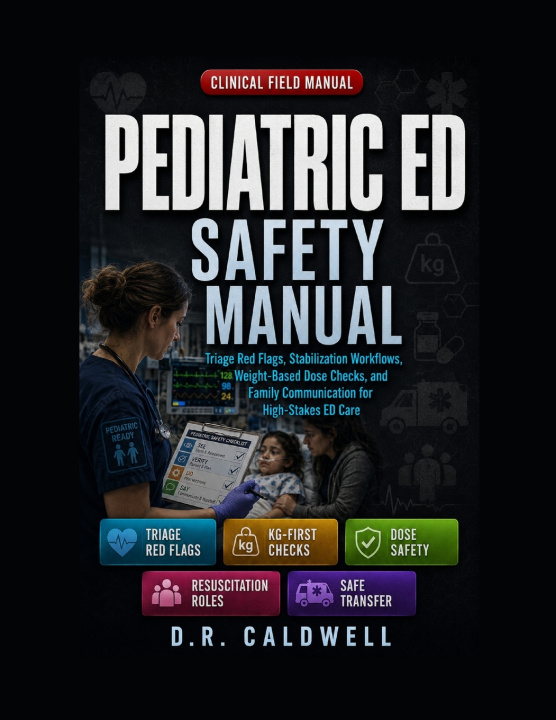
The Pediatric Emergency Nursing Safety Manual
Triage Red Flags, Stabilization Workflows, Weight-Based Dose Checks, and Family Communication for High-Stakes ED Care
 engleză
 500 b
500 b
 Nou
Nou
Până la 30 de zile pentru returnare

Pediatric Emergency Nursing, Where Rare Cases Carry the Highest Stakes
The child who worries you most may be the one you treat least often. In a community, rural, or mixed ED, pediatric arrivals are rare, so skills fade between them. You handle adult emergencies with steady, practiced confidence. Then a sick infant reaches the doorway, and the doses, weights, and sizes all change at once. This manual hands you a calm, repeatable safety system for those moments.
You Already Know the Margin for Error Is Zero
One misread weight quietly becomes a dangerous tenfold overdose. One quiet, tiring infant gets undertriaged and crashes in the waiting room. One frozen resuscitation loses the minutes that mattered. These are not rare stories; they are low volume meeting high risk. When pediatric cases are scattered across months, memory alone fails you. The cost of one missed red flag is a child harmed.
A See, Verify, Do, Say System You Can Run Every Shift
This manual turns scattered knowledge into four moves you repeat until automatic. You see the sick child with a hands-off doorway assessment and red flags. You verify every dose with a kilogram-first weight and a five-point cross-check. You do the stabilization with clear roles and pre-sized equipment. You say the hard things with escalation and family scripts. Kilogram-first dosing anchors it all; the weight is the most dangerous input in pediatric care.
Tools You Reach For, Not Theory You Wade Through
Every chapter ends in a named tool, and every tool appears blank and completed. You get doorway cards, red-flag tables, and reassessment triggers. You get the five-point dose worksheet, the independent double-check script, and tenfold-error drills. You get resuscitation role cards, equipment-sizing tables, escalation ladders, and handoffs. Four worked cases cover triage, medication, resuscitation, and transfer end to end. The appendices reproduce every tool as a bedside kit.
Built Around How Emergency Departments Actually Fail Children
Higher pediatric readiness tracks with far lower mortality for critically ill and injured children. This manual is built on that evidence and on current readiness, triage, resuscitation, and medication-safety thinking. It aligns with the seven readiness domains and the nurse coordinator role. No dose, threshold, or algorithm is printed as fixed fact. Each one points you back to your reference, orders, and pharmacy. The discipline this manual teaches is verification, not memorization.
Written for the Nurse Who Has No Time to Waste
You may worry that a pediatric manual will read as too advanced. This one assumes strong adult-emergency skills and rebuilds the pediatric layer on top. You may worry that any clinical book dates quickly. This one teaches a verification system and defers every number to your live references. You may worry that you have no time to read. The tools are scannable mid-shift, so you pull a prompt while the room moves.
Walk Toward the Next Sick Child With a Plan
Confidence in pediatric emergency nursing does not come from pretending these cases are easy. It comes from holding a system you trust when the room fills with noise. Keep this manual at the station and work the tools before you need them. Let the checklists carry the load that memory never should. The next time a critically ill child arrives, your hands will know the sequence.
Give Every Child Who Arrives Your Safest Care
The children who come rarely deserve the same margin as the patients you see all day. Add this pediatric emergency nursing safety manual to your cart and keep it within reach. Turn the dread of low-frequency cases into practiced, prepared care. Start building the system before your next pediatric arrival.


Informații despre carte
engleză

Dăruiește această carte chiar astăzi
Este foarte ușor
1 Adaugă cartea în coș și selectează Livrează ca un cadou 2 Îți vom trimite un voucher în schimb 3 Cartea va ajunge direct la adresa destinataruluiBună ziua! Sunt Libroamiko, consilierul dumneavoastră de cărți.
Cu ce vă pot ajuta?