
 Contact
 Cum să cumpăr

Livrare
Consilier de cumpărături
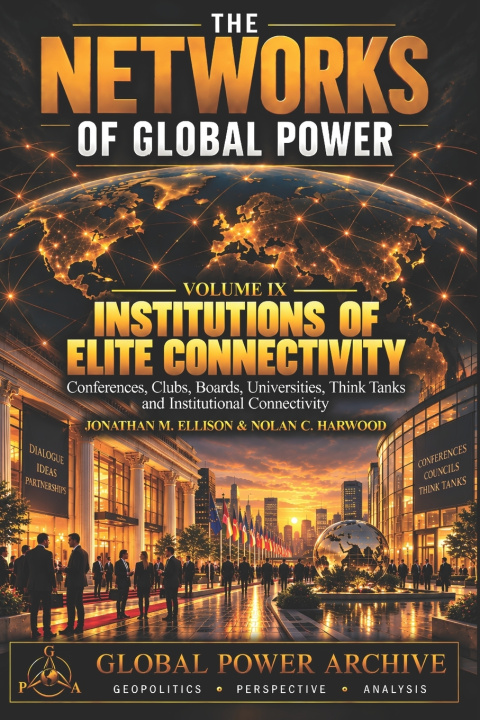
The Networks of Global Power - Volume IX
Institutions of Elite Connectivity
 engleză
 58 b
 Curând
 Nou
Până la 30 de zile pentru returnare

WHEN DO ELITE CONNECTIONS BECOME CONSEQUENTIAL POWER?
Conferences bring political leaders and executives together. Universities sustain alumni relationships across generations. Think tanks connect specialized knowledge with policy debates. Clubs, boards, and professional associations create recurring contact across business, finance, government, academia, and civil society.
But what do these connections actually accomplish? When does access become a usable advantage? And what evidence shows that an institutional relationship has affected a decision or outcome?
The Networks of Global Power - Volume IX: Institutions of Elite Connectivity by Jonathan M. Ellison and Nolan C. Harwood examines these questions through the institutional environments in which elite relationships develop. The volume explains how selection, invitation, and admission shape access; how recurring encounters can support familiarity, trust, and durable relationships; and how institutions connect people operating in otherwise separate sectors. It examines information exchange, expertise, introductions, reputation, reciprocal relationships, and the resources that participants may draw upon through their connections.
The book's distinctive contribution is a framework that traces how institutional connectivity may become consequential influence-and tests each transition against its own evidentiary requirements.
Membership establishes membership. Attendance establishes attendance. A relationship demonstrates a connection. None of these observations alone proves coordinated action, influence, or control. The analysis moves beyond lists of prominent participants to examine the mechanisms through which relationships can become practically usable.
Readers discover why brokerage positions matter, how intermediaries connect separated environments, and when dependence on a particular connection can create relational leverage. They also learn why alternative channels, redundant relationships, and opportunities to bypass an intermediary can weaken that leverage.
The investigation then follows the progression from available resources to actionable capability, mobilization, deployment, and consequential effects. What could an actor actually do? Were the relevant resources activated? Through which institutional pathway? What changed, and how convincingly can that change be attributed to the relationship rather than competing explanations?
Failed power conversion receives the same analytical attention as successful influence. Relationships may remain inactive. Trust may fail to develop. Participants may pursue conflicting interests. Resources may prove unavailable, and resistance or institutional constraints may prevent an attempted intervention from achieving its purpose. These failures reveal the limits of network advantage.
A further distinction is central throughout: an institution does not automatically possess the power of the people it convenes. An organization may facilitate valuable contact without directing participants, controlling their resources, or determining their decisions. Institutional authority, participant capability, shared purpose, coordination, influence, and control therefore require separate examination.
For readers of elite studies, political sociology, institutional analysis, and international affairs, this volume provides a disciplined approach to interpreting affiliations, membership records, recurring encounters, and network structures. It helps readers assess both the opportunities created by institutional connections and the boundaries of what the available evidence can establish.
Understand how institutions connect elites, when those connections become usable, and what it takes to demonstrate their influence.


Informații despre carte
engleză

Dăruiește această carte chiar astăzi
Este foarte ușor
1 Adaugă cartea în coș și selectează Livrează ca un cadou 2 Îți vom trimite un voucher în schimb 3 Cartea va ajunge direct la adresa destinataruluiBună ziua! Sunt Libroamiko, consilierul dumneavoastră de cărți.
Cu ce vă pot ajuta?