
 Contact
 Cum să cumpăr
Livrare
Consilier de cumpărături
The Locker Doesn't Open
 engleză
 173 b
173 b
 Curând
 Nou
Nou
Până la 30 de zile pentru returnare

he problem with most middle school books is that the middle schooler never reads them.
They are long. They are dense. They arrive looking like homework, and they end up on the adult's side of the kitchen table.
This one is built the other way round.
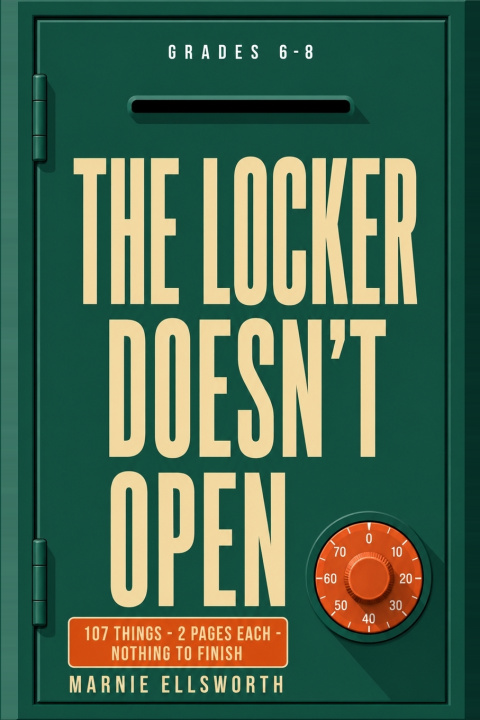
The Locker Doesn't Open is 107 separate things, and every single one takes exactly two pages. Two pages, start to finish, done. No chapter to get through. No earlier section you were supposed to have read. Nothing continues onto a third page. It can be opened at random on a Tuesday, read in four minutes in a corridor, and put down again.
And it runs in the order the year actually happens.
Not tips grouped by theme - the year. August, when the supply list tells you nothing and the last night of summer is very long. The first week, when the locker doesn't open and there are ninety seconds until the bell. September, and where you sit at lunch on day one. October, and the first grade you did not expect. November, when she stops saving you a seat. December, February, the trip in March, the tests in April, and the last afternoon in June.
WHAT EACH OF THE 107 ENTRIES CONTAINS
- A moment. Four or five lines of the thing actually happening - the tray in your hands, the empty hallway, the sheet with the names on it.
- WHAT IS ACTUALLY GOING ON. Why the thing works the way it does, because most of what feels personal at school turns out to be mechanical.
- WHAT YOU CAN DO TODAY. Two or three things, this week. Not a programme.
- And on the entries that need it: THIS ONE IS NOT YOURS TO CARRY ALONE - who to tell, and the exact sentence to open with.
WHAT IS NOT IN HERE
No "believe in yourself". No "you are special". Nothing about bodies, weight, food, sleep or how anyone looks - those subjects do not appear anywhere in this book, in any form. No diagnoses, no clinical words used as labels, no techniques borrowed from therapy. No statistics, no studies, no real cases: every scene was invented while writing, and the book says so on page seven rather than hiding it. No brand names, no app names, no platforms.
And no lecturing. Not one adult in this book explains anything at a young reader.
WHERE THE BOOK STOPS
On bullying, on something spreading where you cannot see it, on a friend telling you something too big, on a hard stretch at home - this book does not offer a clever technique. It says to tell a trusted adult, it names who counts as one, and it hands over the first line, because the first line is the part people get stuck on for weeks.
WRITTEN FOR
Students in grades 6 to 8, roughly ages 11 to 14 - the ones who will not start a 240-page block of text but will finish two pages. Also useful to the adult who bought it: there is a note for you at the front, and it is honest about what a book can and cannot do.
The author is not a teacher, a psychologist or a school counsellor, and does not claim to be. This is not medical, psychological or educational advice.


Informații despre carte
engleză
Categorii
