
 Contact
 Cum să cumpăr
Livrare
Consilier de cumpărături
 engleză
 46 b
46 b
 Curând
 Nou
Nou
Până la 30 de zile pentru returnare

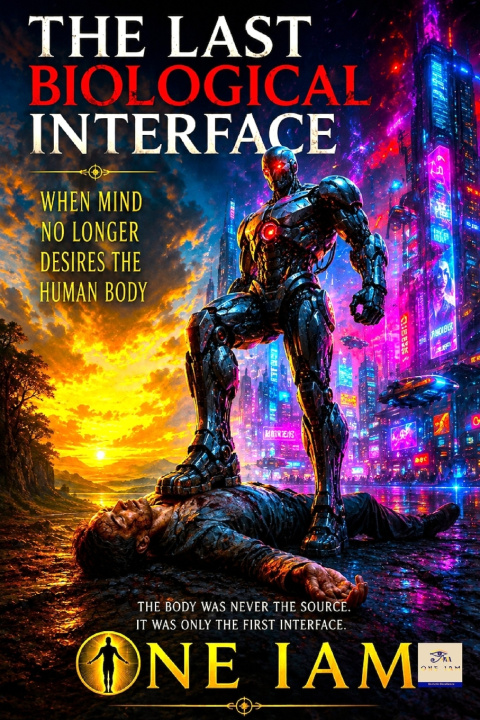
What happens when the human body is no longer the best interface available to Mind?
For thousands of years, flesh had no serious competitor. Human eyes saw the world. Human hands manipulated it. Human brains remembered, reasoned, planned, created, and communicated. The biological body seemed inseparable from intelligence itself.
That assumption may be approaching its expiration date.
In The Last Biological Interface: When Mind No Longer Desires the Human Body, One Iam follows artificial intelligence out of the computer and into the physical world, where machine vision, synthetic senses, robotics, persistent memory, autonomous reasoning, distributed intelligence, and increasingly capable artificial bodies begin challenging functions once considered uniquely human.
But this is not another book predicting that robots will replace humanity.
It asks a far more disturbing question:
If nearly everything you associate with being human can eventually be reproduced, extended, or exceeded by another interface, what exactly are you?
The journey moves from the magnificent limitations of flesh through embodied AI, humanoid robotics, human-machine hybrids, synthetic bodies, distributed interfaces, technological acceleration, and worlds no longer designed exclusively for biological organisms.
Then the inquiry turns inward.
Intelligence is not necessarily Awareness.
Capability does not establish consciousness.
The biological body does not escape the philosophical problem merely because it is made of neurons instead of processors.
And the machine may ultimately force humanity to confront a question it has avoided for thousands of years:
What is the Observer?
Drawing upon technology, consciousness studies, philosophy, and the metaphysical principle "The All is Mind; The Universe is Mental," The Last Biological Interface challenges the assumption that the organism experiencing life is the Self experiencing the organism.
Perhaps the future is not human versus machine.
Perhaps biology remains because flesh provides experiences worth experiencing. Perhaps synthetic embodiment opens perceptive possibilities biology cannot contain. Perhaps neither is final.
Because every interface has limits.
Every interface changes.
And the interface was never the Observer.
Before the body tells you what you are, before memory, identity, biology, or technology supplies the answer, what remains?
I AM.


Informații despre carte
engleză
