
 Contact
 Cum să cumpăr
Livrare
Consilier de cumpărături
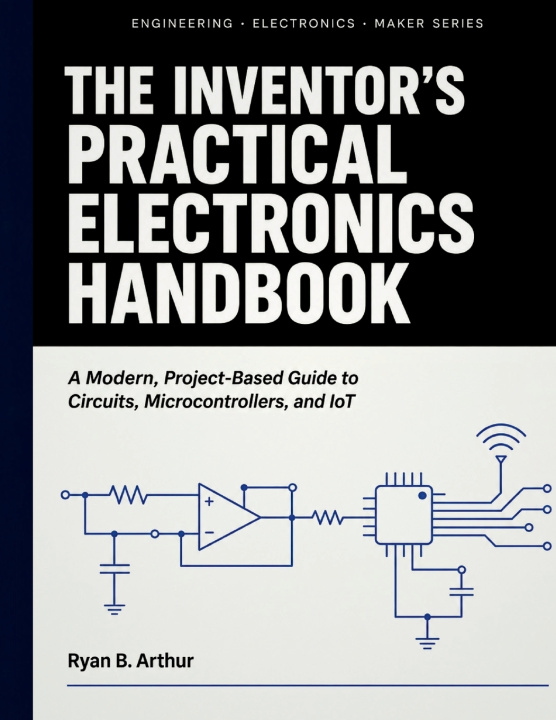
The Inventor's Practical Electronics Handbook
A Modern, Project-Based Guide to Circuits, Microcontrollers, and IoT
 engleză
 66 b
66 b
 Curând
 Nou
Nou
Până la 30 de zile pentru returnare

Every builder's first working circuit is usually preceded by a string of circuits that didn't work - a resistor sized from memory instead of a calculation, a series and a parallel connection quietly swapped, or a part pushed past its rating until it starts to smell hot. That gap between the idea in your head and a circuit that behaves the way you expected is rarely a talent problem. It's a missing set of mental shortcuts, and most resources fail to supply them: dense references front-load formal derivations before a beginner has completed a single working circuit, while lighter project books hand over wiring instructions for one gadget without ever explaining why the circuit works.
This handbook closes that gap with a rule-of-thumb-first method, verified against fully worked, unit-tracked examples and proven out in real hands-on builds - with the full formal derivation available in an appendix for anyone who wants to see exactly where a number came from. Comfort with basic algebra is all that's required to start.
Organized in four progressive parts - Foundations, Signal and Power, Programmable Systems, and Motion, Audio and Delivery - the book runs from Ohm's Law through components, semiconductors, and sensors; operational amplifiers, filters, and timing circuits; power-supply and battery-charging design; digital logic; microcontroller programming and programmable logic devices; short- and long-range wireless connectivity; motor control and audio circuits; and finally the practical realities of taking a working prototype toward a manufactured, compliance-aware product.
Working through it, you will:
Size components and read a schematic using working intuition, checked against fully worked numerical examples with every unit tracked so a wrong answer is easy to catch.
Wire and interface real sensors, program a microcontroller loop that reads them and drives an output, and manage power for a battery-powered design.
Design a regulated power supply, build filters and timing circuits, and work with digital and programmable logic devices.
Build genuinely current connected-device skills, including low-power wireless data links and the basic security questions every connected device raises.
Complete hands-on build projects that connect across chapters, culminating in one integrated, multi-subsystem device rather than disconnected one-off builds.
Understand what changes once a prototype needs to become an actual product - designing for manufacture, realistic cost estimation, and the regulatory and safety questions that come with selling rather than just building.
Every chapter follows the same dependable structure: learning objectives, a rule of thumb before the formal derivation, fully worked examples, a hands-on build or case study, and closing practice problems with a full answer key - supported by two appendices covering the complete math derivations and international wiring standards for readers outside the US-oriented main text.
This book is written for hobbyists, self-taught makers, and students who want to build real, correctly rated electronic devices rather than memorize theory in isolation - readers with basic algebra and genuine curiosity, whether they're wiring their first LED or preparing a working prototype for its first production run.
Open the book and start closing the gap between the circuit in your head and the one actually working on your bench, one verified rule of thumb at a time.


Informații despre carte
engleză

Dăruiește această carte chiar astăzi
Este foarte ușor
1 Adaugă cartea în coș și selectează Livrează ca un cadou 2 Îți vom trimite un voucher în schimb 3 Cartea va ajunge direct la adresa destinataruluiBună ziua! Sunt Libroamiko, consilierul dumneavoastră de cărți.
Cu ce vă pot ajuta?