
 Contact
 Cum să cumpăr

Livrare
Consilier de cumpărături
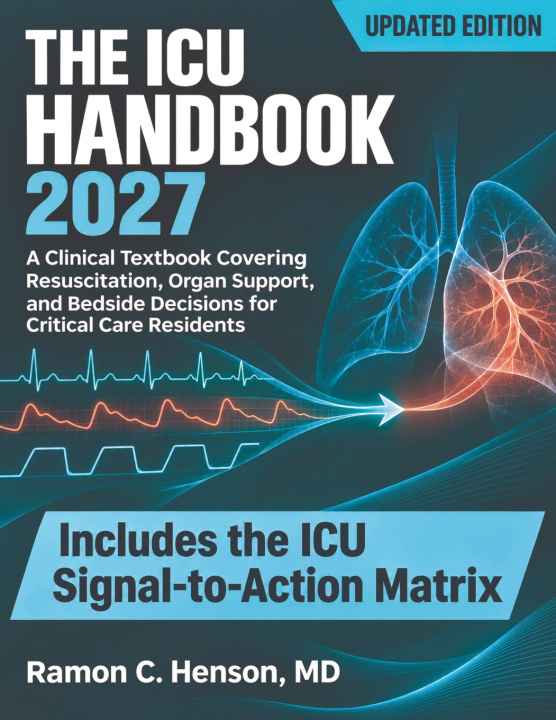
The ICU Handbook 2027
A Clinical Textbook Covering Resuscitation, Organ Support, and Bedside Decisions for Critical Care Residents
 engleză
 193 b
 Curând
 Nou
 Livrăm până la Crăciun ▾
Așteptăm intrarea în stoc
Ediția 19. 11. 2026
Până la 30 de zile pentru returnare

Turn Bedside Signals Into Defensible Critical Care Decisions
Critical illness rarely waits for diagnostic certainty. This clinical reference connects respiratory mechanics, oxygen delivery, hemodynamics, organ failure, infection, neurologic injury, toxicology, trauma, procedures, and recovery to the decisions made during rounds and deterioration. Written for critical care residents and frontline clinicians, it organizes adult ICU medicine around causal physiology, treatment thresholds, and response-to-therapy rather than isolated facts.
Thirty-eight focused chapters integrate current guidance through 2026 with narrative cases, native comparison tables, ICU-native figure specifications, and the ICU Signal-to-Action Matrix. Every decision arc links a verified signal to mechanism, the dangerous mimic, an action threshold, and a reassessment endpoint.
Use the Book to Strengthen These Bedside Capabilities
Interpret ventilator modes, mechanics, waveforms, and capnography - recognize dyssynchrony, auto-PEEP, and injurious support before organ failure advances.
Phenotype shock at the bedside - combine perfusion findings, dynamic fluid assessment, echocardiography, and vasoactive strategy without treating pressure as flow.
Apply current sepsis and ARDS guidance - align antimicrobial timing, source control, lung protection, prone positioning, fluid stewardship, and liberation planning with disease phase.
Stabilize neurologic, renal, hepatic, endocrine, hematologic, and toxicologic emergencies - protect threatened physiology while the causal diagnosis is refined.
Perform and supervise high-risk ICU procedures - plan airway, vascular, pleural, abdominal, ultrasound-guided, and extracorporeal interventions with complication surveillance.
Reduce preventable ICU harm - coordinate analgesia, sedation, delirium care, sleep, nutrition, mobility, device review, infection prevention, and de-resuscitation.
Carry recovery beyond discharge - address weakness, cognition, mental health, caregiver burden, rehabilitation, and post-intensive care follow-up as clinical outcomes.
Bring mechanism, urgency, and reassessment together before the next critically ill patient changes course.


Informații despre carte
engleză

Dăruiește această carte chiar astăzi
Este foarte ușor
1 Adaugă cartea în coș și selectează Livrează ca un cadou 2 Îți vom trimite un voucher în schimb 3 Cartea va ajunge direct la adresa destinataruluiBună ziua! Sunt Libroamiko, consilierul dumneavoastră de cărți.
Cu ce vă pot ajuta?