
 Contact
 Cum să cumpăr

Livrare
Consilier de cumpărături
The Enneagram Hexad
 engleză
 47 b
 Curând
 Nou
 Ediția 15. 11. 2026
Până la 30 de zile pentru returnare

The Enneagram Hexad explores the Enneagram's six-point figure as a living process, not a collection of personality descriptions. Instead of asking, "What type am I?" this book asks a different question: How does experience organize itself into the patterns we eventually experience as personality?
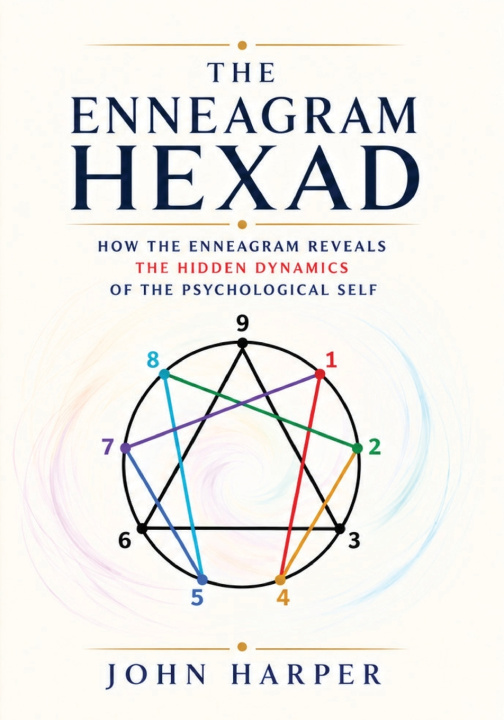
Following the directional movement of the hexad, 1 → 4 → 2 → 8 → 5 → 7 → 1, John Harper examines six fundamental functions of human experience: Determination, Individuation, Relationship, Autonomy, Containment, and Expansion. Each function participates in an ongoing field of tension with the functions around it, receiving what has developed before it, transforming that movement, and transmitting it onward.
Over time, these interacting tensions develop preferred ranges. The nervous system learns what is familiar, manageable, and predictable. Perception, emotion, relationship, action, and attention begin to organize around these ranges, gradually producing the remarkable stability we call the psychological self.
From this perspective, personality is less a fixed thing we possess than a pattern we continually recreate.
The book introduces concepts such as tension fields, dynamic inertia, preferred ranges, receiving and transmitting modes, shock, the missing third force, and the role of Presence in interrupting mechanical continuity. It also explores how developmental history, nervous-system regulation, object relations, attention, and identification shape and sustain psychological organization.
This approach does not replace the Enneagram of Personality Types. It moves underneath it. The familiar patterns of personality remain visible, while the hexad offers another way of understanding the processes through which those patterns form, stabilize, repeat, and occasionally become available for transformation.
The result is an Enneagram concerned less with categorizing the person and more with observing the movement that continually creates the person.
For readers already familiar with the Enneagram, The Enneagram Hexad offers a different doorway into the symbol. For readers interested in consciousness, developmental psychology, phenomenology, nervous-system regulation, or spiritual transformation, it presents the Enneagram as a map of something far more intimate than type: the ongoing organization of human experience itself.


Informații despre carte
engleză

Dăruiește această carte chiar astăzi
Este foarte ușor
1 Adaugă cartea în coș și selectează Livrează ca un cadou 2 Îți vom trimite un voucher în schimb 3 Cartea va ajunge direct la adresa destinataruluiBună ziua! Sunt Libroamiko, consilierul dumneavoastră de cărți.
Cu ce vă pot ajuta?