
 Contact
 Cum să cumpăr

Livrare
Consilier de cumpărături
 engleză
 108 b
 Nou
Până la 30 de zile pentru returnare

What if human difference is not merely something evolution permits, but something that helps complex societies survive?
Across the natural world, variation is everywhere. No two organisms are precisely alike. No two minds process reality in exactly the same way. Yet human societies have repeatedly organized themselves around ideals of uniformity, treating differences in cognition, behavior, sexuality, and social expression as deviations from an assumed norm.
But what if we have misunderstood the significance of those differences?
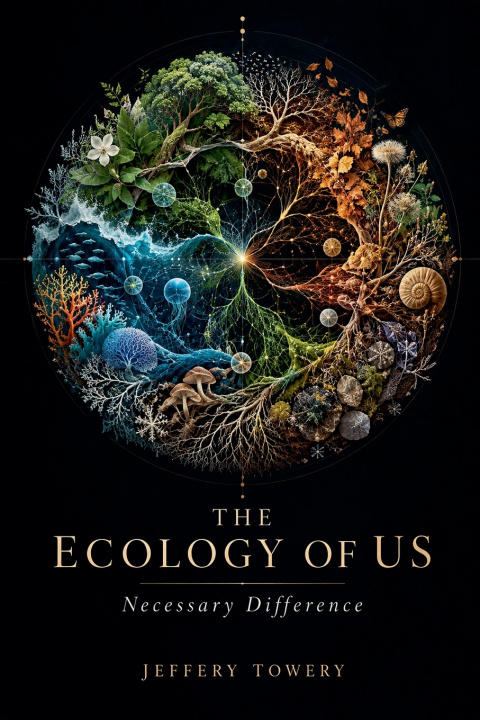
In The Ecology of Us: Necessary Difference, Jeffery Towery undertakes an ambitious interdisciplinary investigation into the origins, functions, and potential evolutionary significance of human diversity.
Drawing upon evolutionary biology, developmental science, cognitive psychology, ecology, network theory, and complex systems research, Towery explores a fundamental question: Could variation itself contribute to the adaptability, resilience, and cooperative potential of human populations?
The investigation moves from the biological foundations of individual development to the emergence of collective behavior, examining how different cognitive architectures, behavioral tendencies, and social strategies may interact within larger systems.
Central to this exploration is the Bias-Amplitude Model (BAM), a proposed theoretical framework for investigating differences in cognitive processing, attentional regulation, and social orientation. Rather than presenting neurodiversity as a collection of deficits or advantages, the model considers cognitive variation within the broader dynamics of biological and environmental systems.
The book also examines sexual and gender diversity, developmental variation, social cooperation, specialization, and the possibility that heterogeneous populations may possess capacities unavailable to more uniform groups.
But Necessary Difference is not an argument that diversity is universally beneficial.
Throughout this extensive scientific examination, Towery deliberately confronts competing explanations, methodological limitations, contradictory evidence, and the circumstances under which variation may impose costs rather than advantages.
Established findings are distinguished from theoretical interpretations. Speculative propositions are identified. Alternative hypotheses are examined, and potential experimental approaches are proposed.
The result is not a declaration of scientific certainty, but an invitation to investigate a profound possibility: that some of the differences humanity has historically struggled to accommodate may be deeply connected to the mechanisms through which complex living systems adapt, cooperate, and endure.
Written for scholars, researchers, professionals, and intellectually curious readers, The Ecology of Us: Necessary Difference offers a substantial exploration of biological diversity, human cognition, social organization, and the evolving relationship between individuals and their environments.
Why can't we all just get along?
It may be what we evolved to do.


Informații despre carte
engleză

Dăruiește această carte chiar astăzi
Este foarte ușor
1 Adaugă cartea în coș și selectează Livrează ca un cadou 2 Îți vom trimite un voucher în schimb 3 Cartea va ajunge direct la adresa destinataruluiBună ziua! Sunt Libroamiko, consilierul dumneavoastră de cărți.
Cu ce vă pot ajuta?