
 Contact
 Cum să cumpăr
Livrare
Consilier de cumpărături
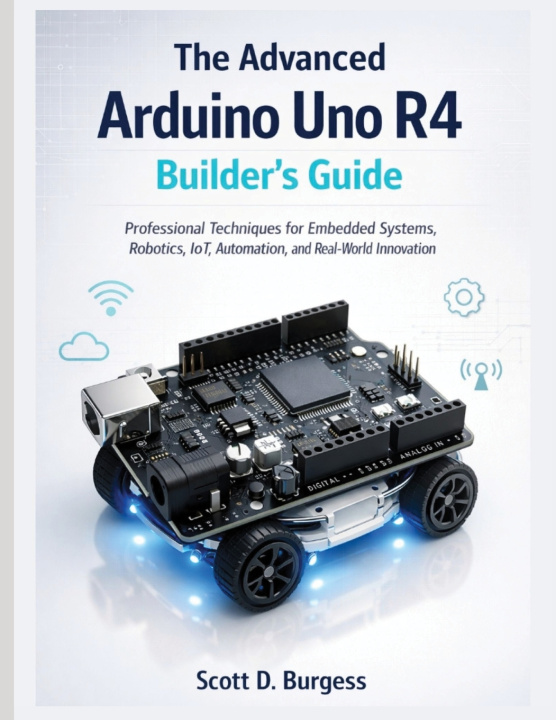
The Advanced Arduino Uno R4 Builder's Guide
Professional Techniques for Embedded Systems, Robotics, IoT, Automation, and Real-World Innovation
 engleză
 47 b
47 b
 Nou
Nou
Până la 30 de zile pentru returnare

Have you ever built something with your hands and thought, "I could do so much more if I actually understood what I was doing"?
If you've moved past blinking an LED and reading a potentiometer, but you're still not quite sure how to design a real circuit, control a robotic arm with genuine precision, or build something that survives outside your workshop - this book was written for exactly that moment in your journey.
Most beginner guides stop right where things start getting interesting. They teach you to follow instructions, but not to understand the engineering underneath them. This book takes the opposite approach. It assumes you already know the basics, and it's ready to take you the rest of the way - into real embedded systems engineering, the kind used by working professionals, students in serious coursework, and makers who are done settling for "it kind of works."
So what will you actually walk away with?
You'll understand the architecture of a modern 32-bit microcontroller well enough to know exactly why it outperforms older 8-bit boards - and, just as importantly, when it doesn't. You'll learn to design circuits that don't just function on a breadboard, but hold up electrically: proper power regulation, noise-resistant signal paths, and analog front-ends you can actually trust. You'll build real robots - line followers, robotic arms with inverse kinematics, autonomous rovers that plan their own paths and avoid obstacles they weren't told about in advance.
You'll connect your projects to the wider world, too. Secure cloud reporting. Real-time dashboards. Industrial-grade communication protocols that let a small board talk to the same kind of equipment used on factory floors. And if you've ever wondered how "smart" devices actually make decisions on their own, you'll get a hands-on introduction to running lightweight machine learning models directly on constrained hardware - no cloud required.
What makes this book different from the dozens of others on the shelf?
It doesn't just show you code and expect you to trust it. Every technique is explained with the reasoning behind it - the tradeoffs, the failure points, the decisions a working engineer actually has to make. You'll find full, working case studies throughout: a multi-sensor environmental monitoring node, a distributed automation system, a solar-powered remote station built to survive weeks without anyone checking on it, and three complete capstone projects that pull every skill in the book together into a single, working build.
You'll also learn what most hobbyist material skips entirely: how to write firmware that's clean and maintainable rather than a tangle of copy-pasted examples, how to test and validate your work like a professional rather than hoping for the best, how to design an enclosure that actually protects your electronics, and what genuinely changes when a project stops being a prototype and starts being something you could hand to someone else - or even bring to a small production run.
Who is this book for?
If you're an engineering student looking to connect classroom theory to something you can actually build and hold. If you're a hobbyist who's outgrown copy-paste tutorials and wants to understand what's really happening in your circuits. If you're a professional evaluating affordable hardware for serious prototyping work. Or if you're simply someone who wants to build genuinely impressive things and is done being told to wait until "the advanced book."
This is that book.
Ready to stop following instructions and start engineering?
Scroll up, grab your copy, and let's build something real.


Informații despre carte
engleză

Dăruiește această carte chiar astăzi
Este foarte ușor
1 Adaugă cartea în coș și selectează Livrează ca un cadou 2 Îți vom trimite un voucher în schimb 3 Cartea va ajunge direct la adresa destinataruluiBună ziua! Sunt Libroamiko, consilierul dumneavoastră de cărți.
Cu ce vă pot ajuta?