
 Contact
 Cum să cumpăr

Livrare
Consilier de cumpărături
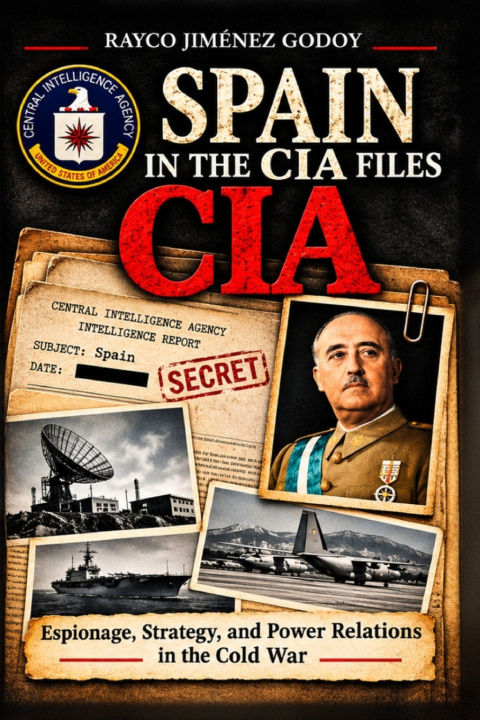
Spain in the CIA files
: Espionage, strategy and power relations in the Cold War.
 engleză
 50 b
 Nou
 Livrăm până la Crăciun ▾
În depozitul extern
Expediem în 9-13 zile
Până la 30 de zile pentru returnare

What did the CIA really know about Franco's Spain? What did Washington expect after the dictator's death? And how did American intelligence interpret the events that transformed Spain into a modern democracy?
For decades, Spain occupied a unique and often uncomfortable position in American foreign policy. It was a dictatorship that became a strategic partner, a country whose military bases were essential to Western defense, and a nation whose political future remained uncertain long after the Second World War.
Behind the official diplomatic statements, American intelligence analysts were watching.
Spain in the CIA Files takes readers inside the world of declassified American intelligence documents to explore how Washington viewed Spain during some of the most decisive decades of the twentieth century.
Drawing on historical records preserved in the CIA's declassified archives, Rayco Jiménez Godoy reconstructs the concerns, expectations, strategic calculations, and occasional misjudgments of an intelligence establishment determined to understand Spain's role in the Cold War.
In 1945, Francisco Franco had survived the defeat of his former Axis partners. Internationally isolated and economically weakened, his regime appeared increasingly vulnerable.
Yet the emerging confrontation between the United States and the Soviet Union changed everything.
Spain's geographical position, its Atlantic and Mediterranean access, and its fiercely anticommunist government made Franco an uncomfortable but potentially valuable partner.
What followed was a relationship shaped by military necessity, political contradictions, and mutual suspicion.
This is not a conventional history of Spain, nor a collection of sensational conspiracy theories.
It is an exploration of how a global superpower observed another country, assessed its political leaders, anticipated possible crises, and sought to protect its own interests.
The intelligence documents reveal something particularly fascinating: not simply what happened, but what American analysts believed might happen next.
Sometimes their predictions proved remarkably perceptive. At other times, uncertainty, incomplete information, and political assumptions shaped their conclusions.
The difference between intelligence assessments and historical reality runs throughout the book.
BEYOND THE HEADLINES. BEHIND THE DIPLOMACY. INSIDE THE ARCHIVES.
Written in an accessible, journalistic style, Spain in the CIA Files brings together political history, international relations, intelligence analysis, and Cold War geopolitics.
The book also includes documentary references and illustrated appendices featuring historical intelligence records, allowing readers to explore the archival foundations of the narrative.
Whether you are interested in Francisco Franco, the CIA, the Cold War, Spanish history, espionage, or the hidden dimensions of international diplomacy, this book offers a distinctive perspective on a turbulent historical era.
Discover Spain as Washington saw it. Explore the documents. Question the predictions. Understand the history.
Spain in the CIA Files invites you to look beyond the familiar historical narrative and discover how American intelligence interpreted the country at the crossroads of dictatorship, democracy, and the Cold War.


Informații despre carte
engleză

Dăruiește această carte chiar astăzi
Este foarte ușor
1 Adaugă cartea în coș și selectează Livrează ca un cadou 2 Îți vom trimite un voucher în schimb 3 Cartea va ajunge direct la adresa destinataruluiBună ziua! Sunt Libroamiko, consilierul dumneavoastră de cărți.
Cu ce vă pot ajuta?