
 Contact
 Cum să cumpăr
Livrare
Consilier de cumpărături
 engleză
 26 b
26 b
 Curând
 Nou
Nou
Până la 30 de zile pentru returnare

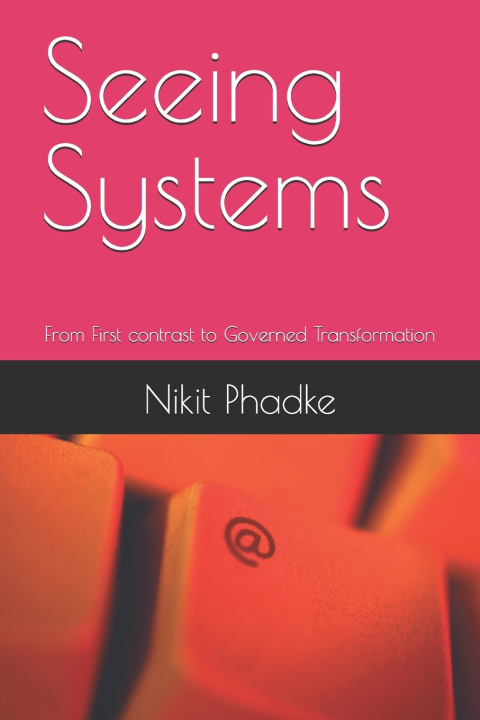
A till that doesn't balance. A calendar that double-books. A tap that has dripped through three family meetings.
You already know how to see the differences that matter - you do it every time something feels wrong. What you may not have is a way to hold that feeling still long enough to work on it. Seeing Systems teaches exactly that: a complete, learnable method for understanding why systems break, why broken stays broken, and how to change things so the change actually holds.
The book's claim is simple and large: a café, an inbox, and a household are the same kind of thing. Every system - a business, a codebase, a family, a country - must answer the same thirty-two questions: What currently exists? How does it change? What must remain true? Who decides? Who waits? Every trustworthy answer rests on the same eight guarantees - records that match reality, acts that trace to valid grants, measures that stay honest when people start aiming at them. And every failure, from a padded invoice to a leaked secret to a rule that outlived its reason, is one of exactly twelve ways of breaking - an alphabet of violation you will recognize instantly, because you have been watching it since childhood without names.
You learn all of it through three small worlds that run through every chapter: a corner café with twelve tables and a half-finished tablet migration; one person's inbox, calendar, and assistant (human or AI - it makes no difference, and the book shows why); and a family of five with a chore rota, a medicine schedule, and a fridge door that turns out to be a complete information system. No computers required. No mathematics until the final part - and when the symbols finally arrive, they fit in a single chapter, because by then you won't need the pages.
But this is not a book of pattern-spotting. It teaches the whole cycle: extract the differences that matter, name the questions in play, declare what must remain true, diagnose how it broke (with a four-step procedure that ends every "we just need to try harder" conversation permanently), choose changes that are genuinely improvements rather than distortions in disguise - and govern the whole thing so it stays honest. You'll learn why the same move - merging, splitting, suppressing - is innovation in one context and injury in another, and the one-line rule that tells them apart. You'll learn to detect theatre (strike out the terminology and see what remains), to catch the metric that improved while reality didn't, and to ask the quietly devastating question almost no audit asks: was the thing evaluated the thing that shipped?
The book culminates in four complete walkthroughs - the café, the inbox, the household, and a payment system at full engineering resolution - followed by a sixty-day protocol for running the method on a system of your own, producing six concrete artifacts a stranger could check.
Capability travels with conscience throughout: every chapter that teaches how things break also teaches the governance of that knowledge, in the same breath. And the book is honest about its one permanent limit - it can keep any values honest; it cannot tell you what to value.
For auditors, engineers, founders, managers, parents - anyone responsible for a system they didn't fully design and can't fully control.
The elegance of a system does not come from fancy mathematics. It comes from the simple, nuanced application of things people already know to things they already do.


Informații despre carte
engleză

Dăruiește această carte chiar astăzi
Este foarte ușor
1 Adaugă cartea în coș și selectează Livrează ca un cadou 2 Îți vom trimite un voucher în schimb 3 Cartea va ajunge direct la adresa destinataruluiBună ziua! Sunt Libroamiko, consilierul dumneavoastră de cărți.
Cu ce vă pot ajuta?