
 Contact
 Cum să cumpăr
Livrare
Consilier de cumpărături
Rodinia
 engleză
 31 b
31 b
 Curând
 Nou
Nou
 Termenul este necunoscut
Până la 30 de zile pentru returnare

More than a billion years ago, Earth had land, oceans, atmosphere, energy, and life-but the planet still did not fully work as a living system.
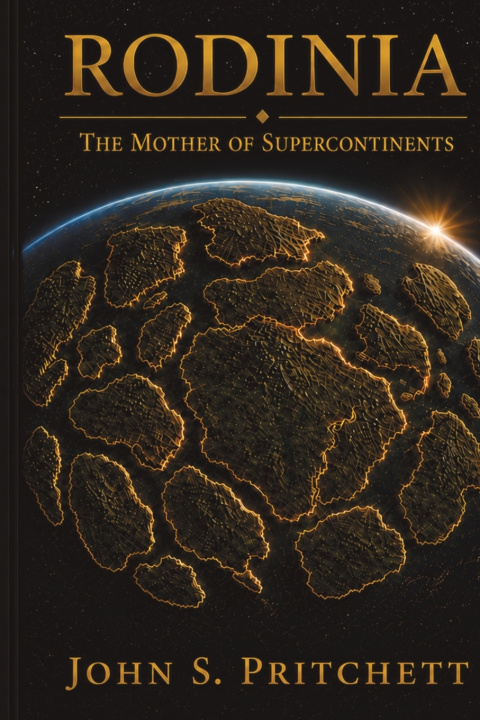
Rodinia: The Mother of Supercontinents explores a vanished world in which the essential ingredients for habitability were present but poorly coordinated. The land was barren and exposed. Oxygen existed, but it was low and unstable. Ozone formed, but protection from ultraviolet radiation did not hold consistently. Water supported life in the oceans, yet the continents lacked mature soils, rooted vegetation, and dependable systems for retaining moisture and nutrients.
John S. Pritchett presents Rodinia not simply as an ancient arrangement of joined landmasses, but as a crucial stage in the development of Earth itself.
Rodinia was a planet that almost worked.
Its immense interior lay far from the moderating influence of the oceans. Rain fell on bare rock and quickly ran away. Nutrients were released but not held in place. Temperature extremes intensified inland, while climate feedbacks could push the planet toward severe cooling and later warming.
Life persisted, but mostly within water.
The oceans reduced radiation, moderated temperature, circulated nutrients, and provided the continuity the land could not. Microbial communities survived in shallow marine environments where sunlight, chemistry, and protection came together. Along tidal margins, repeated cycles of submersion and exposure created changing conditions in which new biological possibilities could emerge.
The problem was not the absence of life. It was that life could not yet scale.
The book examines:
- Unstable oxygen and uneven ozone protection
- A surface exposed to ultraviolet radiation
- Vast dry interiors far from ocean moisture
- The absence of mature soil systems
- Poor retention of water and nutrients on land
- Climate feedbacks capable of driving extreme cooling and warming
- A hotter, more tectonically active Earth
- Oceans that protected life while also confining it
Rodinia's importance becomes clearest when the supercontinent begins to break apart. Rifting opens new ocean basins. Coastlines multiply. Shallow marine environments expand. Ocean circulation changes. Moisture reaches more regions, and exchanges among land, water, atmosphere, minerals, and life become more active.
The breakup does not suddenly create the modern Earth. It does something more fundamental: it begins loosening several constraints at once.
Rodinia's assembly concentrated the problem. Its breakup changed the conditions under which the problem could eventually be solved.
As biological activity became more sustained in expanding marine environments, oxygen production could become more reliable. More consistent oxygen supported stronger ozone formation. Better protection reduced surface radiation. New coastlines created additional zones where sunlight, nutrients, water, and life could interact.
Accessible, richly illustrated, and grounded in geology, climate science, oceanography, atmospheric chemistry, and the history of life, Rodinia: The Mother of Supercontinents reveals why habitability depends on more than the presence of the right ingredients.
It depends on whether planetary systems reinforce one another-and whether favorable conditions persist long enough for complexity to build.
Rodinia was not the first world or the final world. It was the world in which the difference between having the pieces and having a functioning system began to emerge.


Informații despre carte
engleză

Dăruiește această carte chiar astăzi
Este foarte ușor
1 Adaugă cartea în coș și selectează Livrează ca un cadou 2 Îți vom trimite un voucher în schimb 3 Cartea va ajunge direct la adresa destinataruluiBună ziua! Sunt Libroamiko, consilierul dumneavoastră de cărți.
Cu ce vă pot ajuta?