
 Contact
 Cum să cumpăr
Livrare
Consilier de cumpărături
Redbud Tree Biology and Management
A Scientific Approach to Establishing, Protecting, and Sustaining Cercis
 engleză
 58 b
58 b
 Nou
Nou
Până la 30 de zile pentru returnare

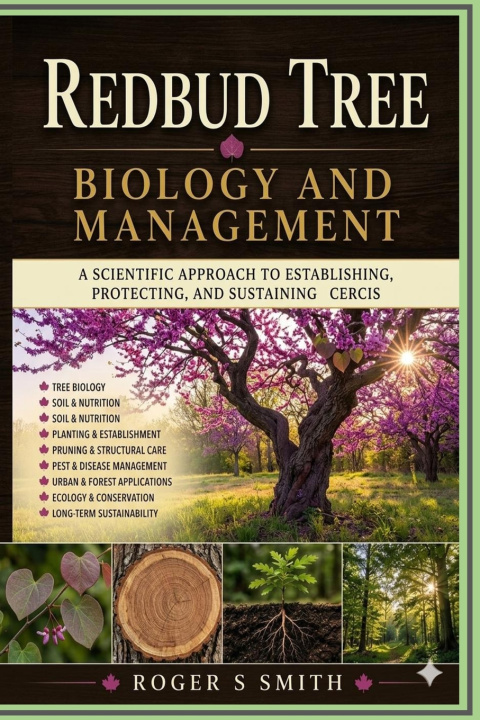
Redbud Tree Biology and Management
A Scientific Approach to Establishing, Protecting, and Sustaining Cercis
By Roger S Smith
Discover the science behind one of North America's most treasured flowering trees in Redbud Tree Biology and Management: A Scientific Approach to Establishing, Protecting, and Sustaining Cercis by Roger S Smith. This comprehensive guide explores the biology, ecology, cultivation, and long-term care of redbud trees through an evidence-based approach designed for arborists, horticulturists, landscape professionals, students, conservationists, and dedicated tree enthusiasts.
Redbuds (Cercis spp.) are more than beautiful spring-flowering ornamentals. They are ecologically important trees that support pollinators, contribute to biodiversity, improve urban environments, and provide valuable ecosystem services. Their vibrant flowers, unique growth characteristics, adaptability, and ecological relationships make them essential components of sustainable landscapes and natural ecosystems.
This scientifically detailed book examines every major aspect of redbud biology and management, beginning with the evolutionary history, taxonomy, and classification of Cercis. Readers will gain an understanding of species diversity, genetic variation, evolutionary relationships, and the characteristics that distinguish Eastern redbud, Texas redbud, Western redbud, Chinese redbud, and important cultivated varieties.
The book provides an in-depth exploration of redbud anatomy and physiology, including root systems, vascular tissues, leaves, flowers, seeds, photosynthesis, respiration, carbohydrate storage, water movement, nutrient transport, and seasonal growth cycles. By understanding how redbuds function biologically, readers can make more informed decisions about planting, maintenance, and problem prevention.
Comprehensive chapters on soil science, mineral nutrition, irrigation, and environmental adaptation explain how redbuds interact with their growing environment. Topics include soil texture, pH management, organic matter, microbial relationships, nutrient deficiencies, fertilizer strategies, drought response, flooding injury, climate adaptation, and regional performance.
Readers will also learn the science behind selecting and establishing healthy redbud trees, including nursery production, propagation methods, seed dormancy, stratification, grafting, tissue culture, planting techniques, transplant care, and early establishment practices. Detailed guidance on pruning biology, canopy development, structural stability, and wound response helps ensure the development of strong, long-lived trees.
The book examines the ecological importance of redbuds, including their relationships with bees, butterflies, birds, wildlife communities, beneficial fungi, and surrounding plant systems. It also explores their role in conservation biology, habitat restoration, sustainable landscapes, carbon sequestration, stormwater management, urban forestry, and climate-resilient planting strategies.
Advanced topics include modern breeding programs, genomic research, biotechnology, disease resistance, precision arboriculture, and future scientific developments shaping the next generation of redbud management. The book also addresses emerging challenges such as climate change, invasive species, new pests and pathogens, habitat loss, and the importance of adaptive management.
Included reference sections provide practical scientific tools, including:
• Seasonal redbud maintenance schedules
• Soil and nutrient reference tables
• Irrigation guidelines
• Fertilizer calculation principles
• Species and cultivar comparisons
• Propagation information
• Pruning recommendations
• Growth expectations and lifespan considerations


Informații despre carte
engleză
