
 Contact
 Cum să cumpăr

Livrare
Consilier de cumpărături
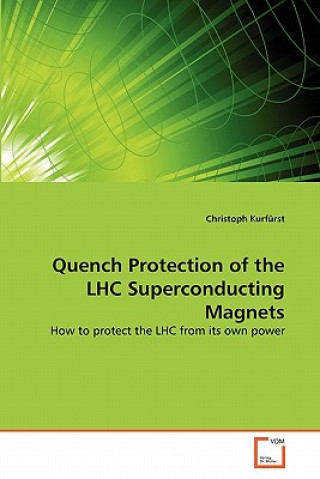
Quench Protection of the LHC Superconducting Magnets
 engleză
 144 b
Până la 30 de zile pentru returnare
Clienții au cumpărat de asemenea
 /
 Carte broșată
 90.99
lei


 /
Carte broșată
275.39
lei
 /
Carte broșată
291.08
lei


 /
Carte broșată
250.56
lei


 /
Carte broșată
196.56
lei

 /
Carte broșată
61.73
lei











CERNs Large Hadron Collider (LHC) broke major records as a new high energy proton accelerator. Its design allows to reach unprecedented beam energies and beam intensities, resulting in a largely increased particle physics discovery potential. The top energy of one beam is comparable to a 400 tons train at 150 km/h. The combination of high beam energy and intensity can have a severe impact on the LHC equipment. To protect the LHC from its own power, a sophisticated redundant security system has been put in place. One of them is the Beam Loss Monitoring system, installed all along the ring. The protection is achieved by extracting the beam from the ring, in case thresholds on beam losses are exceeded. In this study the focus lies on the region between the main magnets of the LHC. Energy deposition in the magnets from beam losses results in a temperature increase. In case a critical temperature is exceeded, a transition from the superconducting state to the normal conducting one will occur. This unwanted transition is called a quench and is avoided using the thresholds on beam losses.


Informații despre carte
engleză
Categorii

Dăruiește această carte chiar astăzi
Este foarte ușor
1 Adaugă cartea în coș și selectează Livrează ca un cadou 2 Îți vom trimite un voucher în schimb 3 Cartea va ajunge direct la adresa destinataruluiAr putea de asemenea, să te intereseze




 /
Carte broșată
225.72
lei
 /
Carte broșată
289.27
lei









 /
Copertă tare
184.90
lei







Bună ziua! Sunt Libroamiko, consilierul dumneavoastră de cărți.
Cu ce vă pot ajuta?