
 Contact
 Cum să cumpăr

Livrare
Consilier de cumpărături
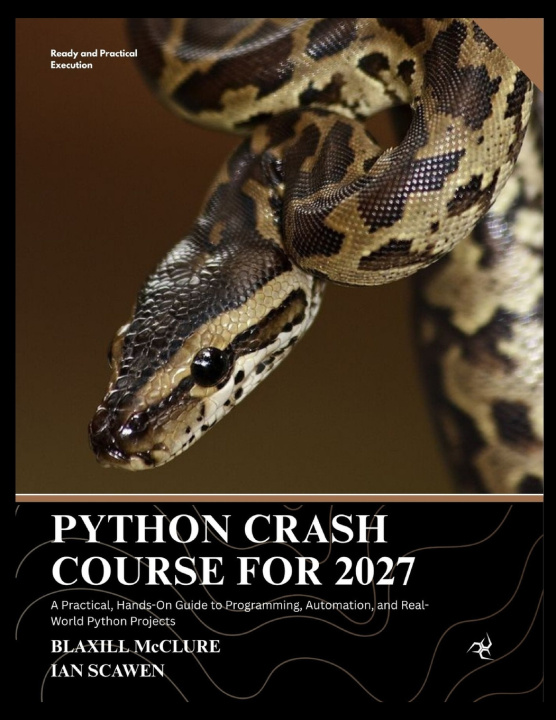
PYTHON CRASH COURSE FOR 2027
A Practical, Hands-On Guide to Programming, Automation, and Real-World Python Projects
 engleză
 74 b
 Curând
 Nou
Până la 30 de zile pentru returnare

You have likely written the same command more times than you can count. Open a folder. Rename forty files by hand. Copy last week's report, change two dates, paste it into the same spreadsheet, and save it under a name you will struggle to find in three months. None of it is difficult. All of it is waste.
Here is the arithmetic that makes it impossible to ignore. A task that takes four minutes and happens twice a week consumes roughly seven hours a year. That figure excludes the errors introduced when you do it tired, the versions that drift apart because one was edited and the others were not, and the hours spent reconstructing what happened after something went wrong. Write a script once, and every one of those costs collapses to near zero. That single trade, repeated across the small recurring tasks of your work, is what Python is actually for.
Imagine replacing that manual cycle with a tool you build in an afternoon. It reads the folder. It normalizes the names. It checks before it overwrites. It logs what it did, so you can prove it tomorrow. It does not get tired on a Friday.
If that calculation interests you, this book is where you learn to perform it.
Python Crash Course for 2027 takes you from installing the interpreter to shipping a tested, packaged, deployed application. It assumes no prior programming experience. Every chapter is hands-on, and every concept is demonstrated in runnable code rather than described in isolation.
What you gain:
A complete command of Python fundamentals, from data types and control flow to functions and scope.
The ability to organize real code into classes, modules, and packages that others can maintain.
Practical automation skill: file operations, web data and APIs, scheduling, and reliable unattended execution.
Data handling with pandas and visualization with matplotlib, applied to files you actually encounter.
A capstone project built end to end, with tests, packaging, and deployment.
The confidence to read an error message and fix it rather than fear it.
What separates this from a reference manual is the guidance around the code. Each section is stacked with targeted exercises that turn reading into doing, common pitfalls that name the mistakes before you make them, and FAQs that answer the questions the text raises but does not pause to address. You will not be left guessing whether you understood a chapter.
You will not be left with exercises and no guidance, either. The pitfalls and FAQs appear exactly where beginners stall: mutable defaults, floating-point comparison, mutable state shared between instances, imports that shadow the standard library, CSV files that gain blank rows, and charts that save as empty images.
One book. Nine chapters. Three parts. A working skill.
Start with the calculation. Then start with chapter one.


Informații despre carte
engleză

Dăruiește această carte chiar astăzi
Este foarte ușor
1 Adaugă cartea în coș și selectează Livrează ca un cadou 2 Îți vom trimite un voucher în schimb 3 Cartea va ajunge direct la adresa destinataruluiBună ziua! Sunt Libroamiko, consilierul dumneavoastră de cărți.
Cu ce vă pot ajuta?