
 Contact
 Cum să cumpăr
Livrare
Consilier de cumpărături
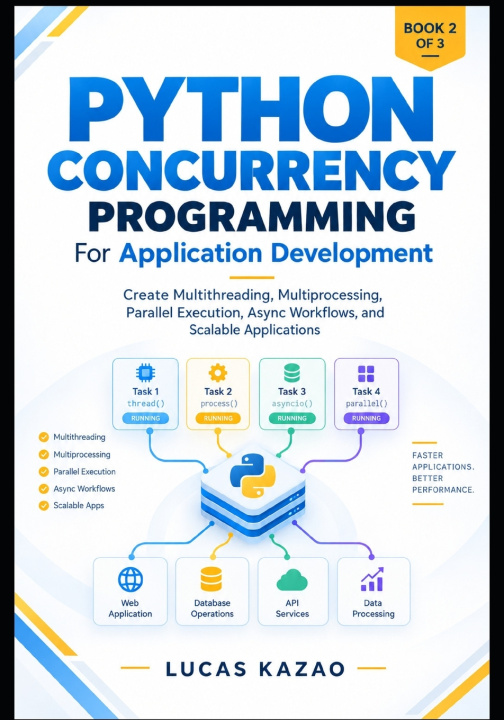
Python Concurrency Programming For Application Development
Create Multithreading, Multiprocessing, Parallel Execution, Async Workflows, and Scalable
 engleză
 44 b
44 b
 Nou
Nou
Până la 30 de zile pentru returnare

Your Python application isn't slow because of Python. It's slow because it's doing one thing at a time.
If your scripts crawl through file I/O, your web service buckles under concurrent requests, or your data pipeline can't keep pace with incoming volume, the problem usually isn't your algorithm it's that your code was never designed to run more than one task at once. This book fixes that, giving you a complete, practical toolkit for making Python applications genuinely concurrent, without falling into the deadlocks, race conditions, and GIL confusion that trip up most developers.
You'll build real, working knowledge of:
Multithreading for I/O-bound work handled safely, with proper locking and synchronization
Multiprocessing to sidestep the Global Interpreter Lock and use every CPU core available
Parallel execution patterns designed around real production workloads, not toy examples
Thread pools, process pools, and executors and exactly when to use each one
Combining concurrency techniques with async workflows for maximum throughput
Debugging and diagnosing concurrency bugs before they reach production
Building scalable, fault-tolerant applications that hold up under real traffic
Rather than abstract theory, every concept in this book is grounded in practical, real-world scenarios: web scrapers that need to hit hundreds of endpoints, data pipelines processing large batches, backend services handling concurrent user requests, and automation scripts that need to finish in minutes instead of hours.
Whether you're a backend developer optimizing an existing codebase, a data engineer building high-throughput pipelines, or an automation specialist tired of watching progress bars crawl, this book gives you the concurrency fundamentals and advanced techniques to make your Python applications faster, more resilient, and genuinely production-ready.
You'll walk away not just knowing how to write concurrent Python, but when and why the difference between developers who copy-paste threading code and those who architect systems that scale.
Stop waiting on slow code. Get your copy now and start building applications that actually use the hardware you're running on.


Informații despre carte
engleză

Dăruiește această carte chiar astăzi
Este foarte ușor
1 Adaugă cartea în coș și selectează Livrează ca un cadou 2 Îți vom trimite un voucher în schimb 3 Cartea va ajunge direct la adresa destinataruluiBună ziua! Sunt Libroamiko, consilierul dumneavoastră de cărți.
Cu ce vă pot ajuta?