
 Contact
 Cum să cumpăr

Livrare
Consilier de cumpărături
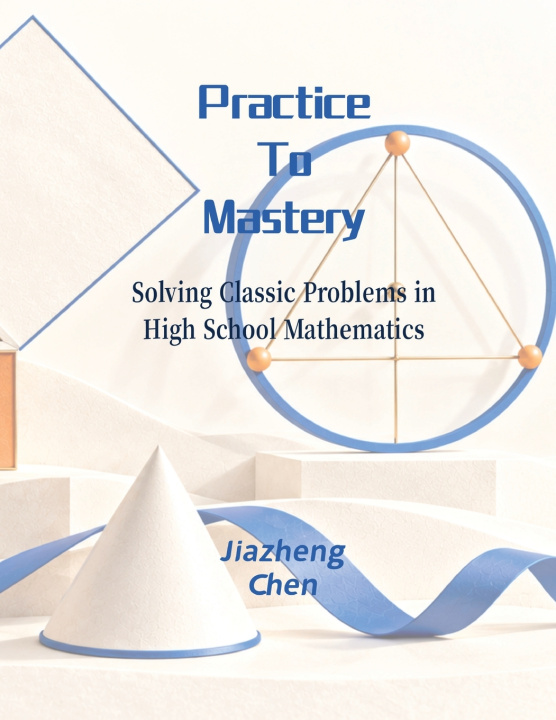
Practice to Mastery
Solving Classic Problems in High School Mathematics
 engleză
 119 b
 Curând
 Nou
Până la 30 de zile pentru returnare

Many high school students understand the ideas in their math class and still get stuck on the problems. They can factor a trinomial, explain what a slope means, and recite the definition of a standard deviation, yet a test question worded a little differently leaves them unsure where to start. A problem they solved last week stops them cold when one condition changes. Knowing the facts is not the same as knowing how to solve problems, and this book is about the second skill.
Practice to Mastery: Solving Classic Problems in High School Mathematics is not a problem bank. Instead, it takes the 53 classic problems that the courses are built on and works each one all the way through. Its 17 chapters are organized in three parts: Algebra (Chapters 1-8: equations and inequalities, lines and linear relationships, systems and matrices, polynomials and factoring, quadratic equations and parabolas, rational expressions, radicals and complex numbers, functions, exponents and logarithms, sequences and word problems), Geometry (Chapters 9-13: angles, parallel lines and proofs, triangles, circles, perimeter, area and volume, coordinate geometry and transformations), and Statistics and Probability (Chapters 14-17: descriptive statistics, probability and counting, probability distributions, sampling and statistical inference). Together they cover the core of Algebra 1, Algebra 2, Geometry, and a high school statistics course.
Every core problem is worked through in the same eight sections: The Problem; What Kind of Problem Is This?; The General Approach; Step by Step; Now Change One Thing...; More Than One Way; Watch Out; and The Takeaway. The heart of the book is Now Change One Thing..., which changes the conditions one at a time so students see which steps stay the same and which have to change. In the flagship Chapter 5, a single quadratic equation is solved by factoring, by square roots, by completing the square, and by the quadratic formula, then drawn as a parabola; change its constant term and it goes from two real solutions to a double root to a pair of complex solutions.
Three habits run through the whole book. In algebra, every equation is handled with the same five steps: simplify, classify, choose a method, solve, and check. In statistics, every data set is handled with the same four steps: identify the type of data, graph it, find its center and spread, and choose the right tool. In geometry, the backbone is the two-column proof, in which every statement comes with a reason. Common formulas are derived rather than simply stated, so students can rebuild them when they forget.
Every step is written out by hand, with no calculator keystrokes and no calculus. Notation follows common U.S. high school usage, the diagrams are simple black-and-white line drawings, and all problems, data, and diagrams are original.
The book is written for students in Algebra 1, Algebra 2, Geometry, and high school statistics who want to work on their own, and for parents, tutors, and teachers who want worked examples to teach from. It builds the algebra, geometry, and statistics foundation for AP® Precalculus, AP® Calculus, and AP® Statistics, and its statistics and probability chapters lead directly into the early content of AP® Statistics. It is not an AP® exam-prep book and does not contain AP®-style practice questions. Precalculus and calculus topics are covered in the companion volumes, Practice to Mastery: Solving Classic Problems in High School Precalculus and Practice to Mastery: Solving Classic Problems in High School Calculus.
AP® and Advanced Placement® are registered trademarks of the College Board, which was not involved in the production of, and does not endorse, this product.


Informații despre carte
engleză

Dăruiește această carte chiar astăzi
Este foarte ușor
1 Adaugă cartea în coș și selectează Livrează ca un cadou 2 Îți vom trimite un voucher în schimb 3 Cartea va ajunge direct la adresa destinataruluiBună ziua! Sunt Libroamiko, consilierul dumneavoastră de cărți.
Cu ce vă pot ajuta?