
 Contact
 Cum să cumpăr
Livrare
Consilier de cumpărături
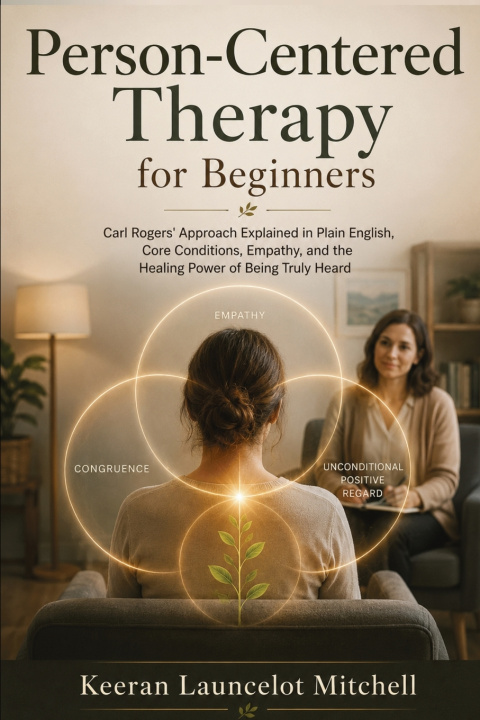
Person-Centered Therapy for Beginners
Carl Rogers' Approach Explained in Plain English, Core Conditions, Empathy, and the Healing Power of Being Truly Heard
 engleză
 41 b
41 b
 Nou
Nou
Până la 30 de zile pentru returnare

Understanding Person-Centered Therapy Should Not Require an Academic Degree
Carl Rogers' approach to therapy is one of the most widely practiced and most persistently misunderstood frameworks in modern psychology. Students, trainee therapists, and helping professionals encounter unconditional positive regard, empathic understanding, and congruence in virtually every training program worldwide. Yet the books that explain these ideas are either dense academic texts priced well beyond the reach of independent learners, or Rogers' own foundational works, written in the philosophical prose of the 1950s. A clear, affordable, plain-English introduction has been missing from this space for a long time.
What This Book Covers
Person-Centered Therapy for Beginners provides a structured introduction to Carl Rogers' full theoretical framework. Beginning with the historical context in which Rogers developed his ideas, the book builds the foundational theory: the actualizing tendency, conditions of worth, self-concept, and incongruence. It then introduces all six of Rogers' necessary and sufficient conditions for therapeutic change, not only the three that most introductions cover. Each of the three core conditions, congruence, unconditional positive regard, and empathic understanding, receives a dedicated chapter with realistic composite examples and annotated session dialogue. Later chapters address the evidence base, cultural considerations, practical applications of Rogers' principles in parenting, education, nursing, and management, and the personal development demands of person-centered practice.
What Makes This Book Different
Most available texts on person-centered therapy are academic titles written for formal course adoption, or Rogers' original works, which assume considerable prior context. This book is written for the self-directed learner who wants a complete and honest account of the approach without needing a course enrollment to make sense of it. Every chapter includes practical reflection exercises, Chapter Eight describes what a person-centered session looks and sounds like with full therapist commentary, and the evidence chapter addresses what research actually shows, including the approach's genuine limits.
This book is for readers who:
Are counseling or psychology students encountering person-centered therapy for the first time and finding the assigned texts difficult to access
Are trainee therapists or early-career practitioners who understand the theory in outline but are not yet confident about what the approach looks and sounds like in practice
Are currently in person-centered therapy and want to understand what their therapist is doing and why the non-directive approach serves their growth
Are professionals in education, nursing, social work, or management who want to understand and apply Rogers' principles within their helping roles
Want an honest, evidence-based account of what person-centered therapy does well, where its limits are, and how it relates to other therapeutic approaches
A Clear Starting Point
For readers who want to understand person-centered therapy, Carl Rogers' six conditions, and the practical and theoretical foundations of one of the most enduring frameworks in psychotherapy, this book provides an accessible, structured, and honest place to begin.


Informații despre carte
engleză

Dăruiește această carte chiar astăzi
Este foarte ușor
1 Adaugă cartea în coș și selectează Livrează ca un cadou 2 Îți vom trimite un voucher în schimb 3 Cartea va ajunge direct la adresa destinataruluiBună ziua! Sunt Libroamiko, consilierul dumneavoastră de cărți.
Cu ce vă pot ajuta?