Livrare gratuită pentru comenzile de peste 349 LEI prin Easybox, FAN BOX și Coletăria.

Faceți parte dintr-o comunitate de iubitori de cărți din întreaga lume și beneficiați de o mulțime de avantaje
Creați-vă un cont gratuit
Transport gratuit la punctele de livrare Pick Up peste 349.00 lei
Packeta 17.50 lei
Urgent Cargus 30.50 lei
Easybox 22.50 lei
Punct FAN 18.50 lei
Punct DPD 19.50 lei
Curier DPD 27.50 lei
FAN Courier 27.50 lei
 Contact
 Cum să cumpăr

Ajutor
Livrare
Packeta 17.50 lei
Urgent Cargus 30.50 lei
Easybox 22.50 lei
Punct FAN 18.50 lei
Punct DPD 19.50 lei
Curier DPD 27.50 lei
FAN Courier 27.50 lei
Transport gratuit la punctele de livrare Pick Up peste 349.00 lei
Consilier de cumpărături
Suntem aici pentru tine!
031 22 95 182
Contul meu
▸
Gol :-(
0
Livrare gratuită pentru comenzile de peste 349 LEI prin Easybox, FAN BOX și Coletăria.
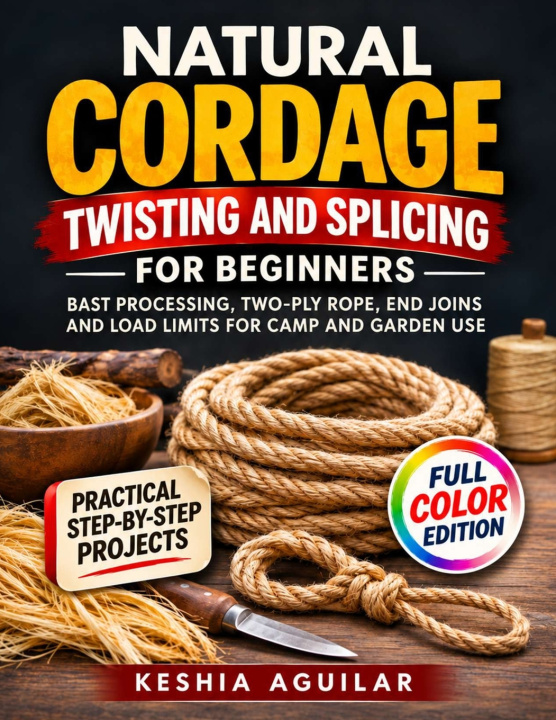
Natural Cordage Twisting and Splicing for Beginners
Bast Processing, Two-Ply Rope, End Joins and Load Limits for Camp and Garden Use
Limba
 engleză
Carte
Carte broșată
Natural Cordage Twisting and Splicing for Beginners takes you from a stand of dogbane, milkweed, cat...
Descrierea completă
Codul Libristo: 54411515
?
 62 b
 Curând
 Nou
62 b
Curând
Nou
135.74
lei
Așteptăm intrarea în stoc
Ediția 10. 11. 2026
Până la 30 de zile pentru returnare

Natural Cordage Twisting and Splicing for Beginners takes you from a stand of dogbane, milkweed, cattail or basswood to finished two-ply cord and three-strand rope. Its 16 chapters cover fiber preparation, twisting, joins, splices and load limits, and it closes with 9 projects for camp and garden.
Plant fibers become handmade cord because twist locks short fibers together, and you learn exactly how that happens, one motion at a time. You also learn which jobs your cord can do and which it must never touch.
From Raw Stalk to Spliced Eye
- Bast processing: cut stalks and bark responsibly, ret the fiber without the mess, then strip, clean and soften it ready for twisting.
- Two hand methods, thigh rolling and reverse wrapping, taught side by side so you can keep the one your fingers prefer.
- Even two-ply cord from start to finish, how to add fiber as you go, and how to fix lumpy, loose or kinked cord.
- Camping knots, joins, loops and hitches, whipped ends that stop cut cord from fraying, and lashings for garden poles.
- Heavier three-strand rope, then the eye splice and the short splice worked with a fid.
- Load limits taken from your own bench tests on short samples, with a Load Limit line on every project header.
Retting, the step that decides how evenly fiber twists, gets a full chapter of its own, with a table of methods, a table of common problems and a log layout so each batch can be repeated. The plant-choice chapter doubles as a plant identification guide, tabulating dogbane, milkweed, wild stinging nettles, basswood, willow and cattail, giving the part used and the main caution for each. The introduction adds flax, hemp and linden to the bast plants.
Twisting plant fiber into string is one of the oldest traditional skills there is, a fiber craft with a long heritage, and the same ancient trick of opposing twist works at your own table. The introduction describes a 6.2-millimeter fragment reported from France and dated to between 52,000 and 41,000 years ago, primitive technology that needed no machine.
Each skill is taught before a project uses it. Every set of numbered instructions restarts at 1 and gives one action per step, so you can follow it with both hands busy. Hand Position callouts show where fingers, thumbs and fibers sit, and Stop and Check callouts mark the moments to look at your work before going on.
The 9 gear projects for camp and garden start with a 36-inch practice cord from leaf strips such as craft raffia and move on to a garden twine hank, reusable plant ties, a bean-pole lashing set, a tool lanyard with an eye splice, tent peg pull loops, a camp drying line, a pea trellis cord ladder and a rope handle for a light garden tote.
Handmade cord is weaker than the manufactured kind, rots if stored damp and varies from one length to the next, and the book says so plainly.
It sets a load limit by proof-testing five short samples with a bucket of water, at 12 times the load you want, or 24 times when a knot or splice sits at the loaded point. Handmade cord is never used for climbing, rescue, fall protection, towing, overhead lifting or anything that carries a person.
Gathering gets care too, with permission asked and small harvests taken from foraged plants. Safety has its own space as well: gloves around dogbane and nettle sap, a sharp blade cut away from your body, an N95 respirator for dusty fiber, and retting water kept out of streams and storm drains.
A knife, hand pruners, a scraper, a fid, a bucket and a kitchen scale cover most of the work, and whipping calls for cotton or linen twine. A Technique Reference and a Project Index close the book, and these outdoor crafts ask for patience more than equipment.
Start with Project 1.
Actriță
&
Poliglotă
EWA KASP
pentru
Redă videoclipul


Libristo are cea mai mare selecție de literatură în limbi străine. De aceea îmi cumpăr cărțile de aici.
Informații despre carte
Titlu complet
Natural Cordage Twisting and Splicing for Beginners
Autor
Keshia Aguilar
Limba
engleză
engleză
Legare
Carte - Carte broșată
Data publicării
2026
Număr pagini
138
EAN
9798167783287
Codul Libristo
54411515
Editura
Independently published
Greutatea
339
Dimensiuni
216 x 280 x 8

Dăruiește această carte chiar astăzi
Este foarte ușor
1 Adaugă cartea în coș și selectează Livrează ca un cadou 2 Îți vom trimite un voucher în schimb 3 Cartea va ajunge direct la adresa destinatarului
Consilier de cărți Libroamiko
Prin utilizarea acestui chat, comunicați cu inteligența artificială generativă. Prin utilizarea acestuia, sunteți de asemenea de acord cu prelucrarea datelor cu caracter personal.
Bună ziua! Sunt Libroamiko, consilierul dumneavoastră de cărți.
Cu ce vă pot ajuta?
Bună ziua, sunt Libroamiko, vă pot ajuta?