
 Contact
 Cum să cumpăr

Livrare
Consilier de cumpărături
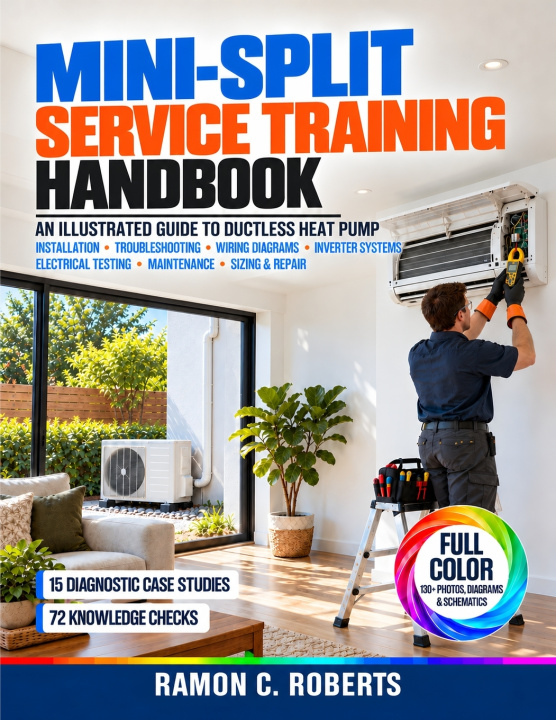
Mini-Split Service Training Handbook
An Illustrated Guide to Ductless Heat Pump Installation, Troubleshooting, Wiring Diagrams, Inverter Systems, Electrical Testing, Maintenance, Sizing & Repair
 engleză
 97 b
 Nou
Până la 30 de zile pentru returnare

Install it right, diagnose it with evidence, and repair it once.
Ductless mini-split heat pumps now heat and cool millions of homes, additions, and small buildings, and every one of them combines line voltage, an inverter drive, a DC bus that can stay charged, sensitive electronics, and a refrigerant circuit under pressure. Mini-Split Service Training Handbook is a full color field guide for the technicians who install and service them. It starts with how a ductless heat pump moves heat and ends with complete diagnostic case studies, with every step explained, illustrated, and tied to the manufacturer's data.
What you will learn
- How the refrigeration cycle, the reversing valve, the electronic expansion valve, and the inverter compressor work together in heating and cooling.
- How to size a system from room loads and block loads, choose capacity from expanded performance data, and avoid the problems that oversizing and undersizing cause.
- How to plan, mount, and connect indoor and outdoor units, make reliable flare connections, run line sets and condensate drains, and pressure test, evacuate, and commission a new installation.
- How to read generic mini-split wiring diagrams, measure safely on supply circuits, understand the inverter's rectifier, DC bus, and power module, and test thermistors, fan motors, and expansion valve coils.
- How control boards communicate, what fault codes can and cannot tell you, and how to find faults in power, communication, sensors, and the refrigerant circuit without replacing parts on a guess.
- How to maintain, clean, and repair mini-splits, and which tasks belong to a qualified technician.
- 24 chapters in six parts, from first principles to field diagnosis
- 130+ full color diagrams, teaching schematics, flowcharts, and photos
- 15 diagnostic case studies, each labeled as a training scenario and worked through one nine-step chain from the customer's complaint to the verified repair
- 19 worked examples with every calculation shown, from superheat and subcooling to additional charge for long line sets
- 72 knowledge-check questions with answers and explanations
- Checklists for site surveys, installation, commissioning, maintenance, and service documentation, plus a copyable service worksheet
- A glossary, symbol chart, quick-reference table, and conversions
The book explains the move to lower-GWP refrigerants such as R-454B and R-32, the handling and tool requirements that come with A2L refrigerants, the SEER2 and HSPF2 ratings, and recent electrical code changes that affect outdoor HVAC equipment. Confirm the edition and local amendments that apply before relying on any rule.
Built around safe, evidence-based practice
Charge is judged from temperatures and pressures together at stable conditions, never from a single gauge reading. Refrigerant is never added simply because cooling is poor. Energized measurements are made only at the points the manufacturer specifies, by qualified technicians with rated meters, and no protective device is ever bypassed. Values that depend on the equipment, such as pressures, resistances, voltages, torques, line lengths, and fault codes, are given only as clearly labeled examples, so you learn the method and then apply it with the documents for the actual model.
Who it is for
HVAC apprentices and students, experienced technicians who are new to ductless and inverter equipment, electricians who wire mini-splits, and service managers who train their teams.


Informații despre carte
engleză

Dăruiește această carte chiar astăzi
Este foarte ușor
1 Adaugă cartea în coș și selectează Livrează ca un cadou 2 Îți vom trimite un voucher în schimb 3 Cartea va ajunge direct la adresa destinataruluiBună ziua! Sunt Libroamiko, consilierul dumneavoastră de cărți.
Cu ce vă pot ajuta?