
 Contact
 Cum să cumpăr
Livrare
Consilier de cumpărături
 engleză
 36 b
36 b
 Curând
 Nou
Nou
 Ediția 01. 10. 2026
Până la 30 de zile pentru returnare

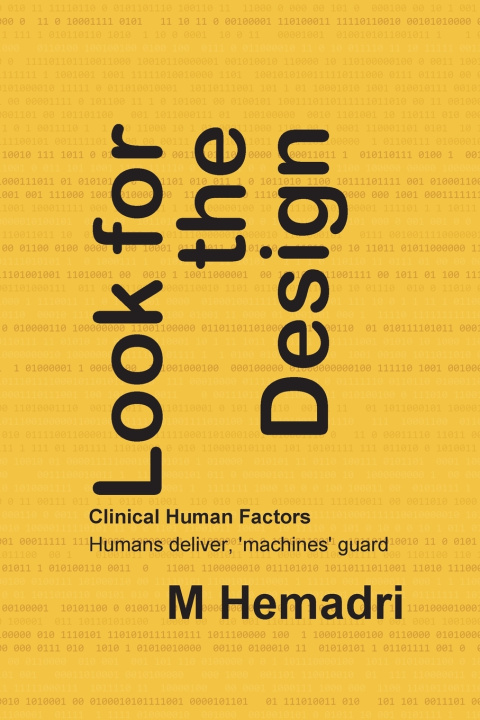
If you work in healthcare, you have probably sat through a human factors session. Communication. Teamwork. Situational awareness. Speaking up. Swiss cheese on the wall. An aeroplane on the slide. You may have left feeling better - and still wondered, months later, whether anything at the sharp end actually changed.
Look for the Design is written for that honest doubt.
Surgeon Makani Hemadri has participated in, taught, and delivered human factors learning for decades. The behavioural lessons matter. They are not the whole story. Across the NHS and health systems worldwide, human factors too often arrived as an imported classroom package - crew resource management, culture, checklists - while the engineering layer that makes aviation's safety story credible stayed at customs. Connectors remained universal. Pumps stayed overrideable. Records stayed open to curiosity. Wards stayed designed for heroism, not for fallible humans under surge.
This book argues that clinical human factors must be **bespoke**: shaped by how care is actually delivered, not copied from another industry's brochure.
What you will find inside
A clear definition: human factors as the **disciplined use of design**, informed by the study of real work - equipment, space, information, tasks, rules, and people - not "be more careful" dressed in new language.
Six principles that explain why generic imports underperform in healthcare: endogenous outcomes (separating unavoidable death from avoidable harm); honest evidence grading; capital versus cheap training; inelastic demand; humans who execute care at the interface; and **design precedence** - what to build before you teach when harm is engineerable.
A fair but firm audit of what healthcare imported from industry and what it left behind. A 'completing James Reason' (metal slices, not attitude only) and using work-system thinking alongside models such as **SEIPS**.
• A practical **catalogue of physical human factors**: NRFit, blunt needles, gas fittings, smart pumps, barcoded medicines, and more - with mechanisms, evidence grades, and the question every board should ask: What do we build first?
Clinical vignettes you will recognise: the endoscopy biopsy forceps that should have been one length; the electronic health record gate that could have protected staff and bereaved families; the investigation that closed on training while the connector was still wrong.
Who this book is for
Clinicians, nurses, allied health professionals, patient safety leads, quality improvers, educators, managers, and executives who are tired of attendance certificates substituting for harm reduction - and who want language, theory, and tools to **look for the design** on the next shift.
Who this book is not for
Readers seeking another teamwork day in print, or a manual that pretends healthcare is an airline. This is clinical, frontline, and unapologetic about the division of labour that matters: humans execute care; 'machines' should guard where avoidable failure modes can be engineered.
M Hemadri is a jobbing frontline NHS general surgeon, who has designed and taught courses on quality improvement, leadership, up to masters level.
If you leave with one habit, leave with this: before you call another course human factors, ask what physical or technical change makes this error difficult, impossible, or immediately visible.
Look for the design. Mean it


Informații despre carte
engleză

Dăruiește această carte chiar astăzi
Este foarte ușor
1 Adaugă cartea în coș și selectează Livrează ca un cadou 2 Îți vom trimite un voucher în schimb 3 Cartea va ajunge direct la adresa destinataruluiBună ziua! Sunt Libroamiko, consilierul dumneavoastră de cărți.
Cu ce vă pot ajuta?