
 Contact
 Cum să cumpăr

Livrare
Consilier de cumpărături
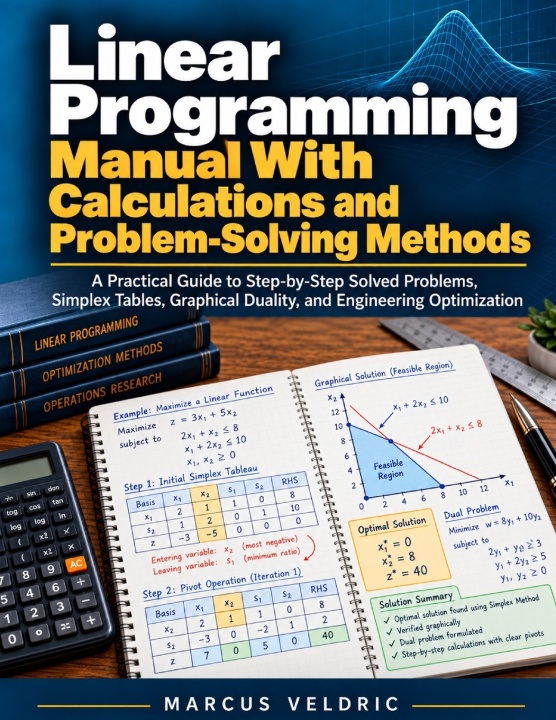
Linear Programming Manual With Calculations and Problem-Solving Methods
A Practical Guide to Step-by-Step Solved Problems, Simplex Tables, Graphical Duality, and Engineering Optimization
 engleză
 97 b
 Nou
Până la 30 de zile pentru returnare

Master the calculation procedures behind linear programming with a practical, step-by-step approach to mathematical problem-solving.
Understanding optimization theory is important, but applying it correctly requires careful calculations, accurate mathematical procedures, and the ability to interpret each stage of a solution.
From constructing objective functions and constraints to performing simplex iterations and evaluating optimal solutions, linear programming calculations can become challenging when intermediate steps are unclear.
Linear Programming Manual With Calculations and Problem-Solving Methods is designed to bridge the gap between understanding optimization concepts and applying mathematical techniques to numerical problems.
With an emphasis on systematic calculations, worked examples, and practical problem-solving procedures, this manual provides a calculation-focused approach to linear programming.
What You Will Explore Inside:
- Step-by-Step Problem Formulation: Practice translating mathematical and engineering problems into objective functions, decision variables, and constraints.
- Graphical Solution Calculations: Work through feasible regions, corner-point evaluations, maximization problems, and minimization problems.
- Simplex Tables and Iterations: Follow tableau construction, pivot-column selection, pivot-row calculations, and iterative solution procedures.
- Duality Calculations: Explore primal and dual problem formulations, mathematical relationships, and solution verification.
- Feasibility and Optimality Checks: Understand how to evaluate constraints, verify candidate solutions, and interpret calculated results.
- Engineering Optimization Problems: Examine numerical applications involving resource allocation, production planning, scheduling, and operational decision-making.
This manual emphasizes the mathematical working behind each solution rather than presenting final answers without explanation.
By organizing problems into clearly defined procedures, it helps readers understand how calculations are performed, why particular steps are necessary, and how results can be checked.
Who Is This Manual For?
This resource is intended for engineering students, applied mathematics students, operations research learners, technical trainees, and readers who want additional practice with linear programming calculations.
It is particularly suited to those studying numerical optimization methods, revising mathematical procedures, or developing a more systematic approach to solving engineering optimization problems.
Move beyond memorizing formulas and begin exploring the calculations, solution methods, and mathematical reasoning behind linear programming problems.


Informații despre carte
engleză

Dăruiește această carte chiar astăzi
Este foarte ușor
1 Adaugă cartea în coș și selectează Livrează ca un cadou 2 Îți vom trimite un voucher în schimb 3 Cartea va ajunge direct la adresa destinataruluiBună ziua! Sunt Libroamiko, consilierul dumneavoastră de cărți.
Cu ce vă pot ajuta?