
 Contact
 Cum să cumpăr
Livrare
Consilier de cumpărături
 engleză
 40 b
40 b
 Curând
 Nou
Nou
Până la 30 de zile pentru returnare

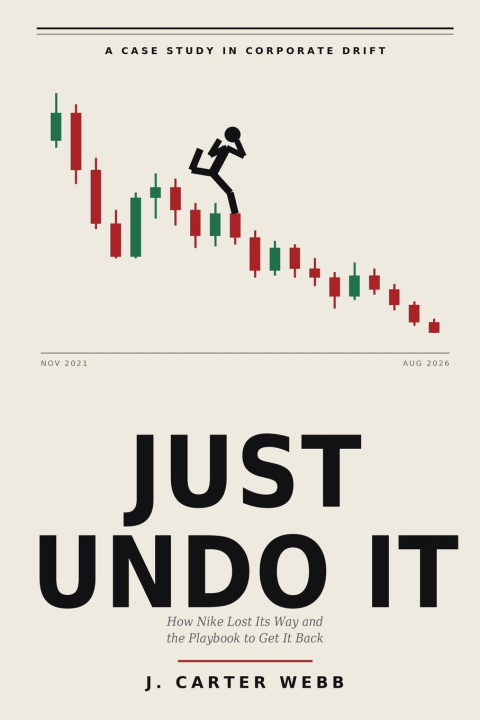
In November 2021, Nike touched $177.51. On August 17, 2026, it closed at $39.09 - a twelve-year low, and roughly $196 billion of erased market value.
This is a case study, not a rant. It puts most of the blame where the evidence puts it: a strategy that severed some fifty wholesale partners, a reorganization that dissolved the sport categories holding forty years of product expertise, and four years in which the pipeline produced refreshes instead of arrivals.
But it asks the question those failures cannot answer. Why did a company famous for killing bad decisions fast take four years to reverse the worst one in its modern history?
The argument here is that Nike gave itself a second set of primary metrics - published them, reported against them annually, attached executive compensation to them - and then spent the years of its collapse succeeding at something it happened to be measuring.
Inside: the operating system that made Nike unbeatable and the correction reflex that was its real moat. The turn from 2018 to 2021, decision by decision. The outsider CEO who dismantled the product organization of a product company. The federal investigation that read a corporate impact report back to its authors eight years later. And a full chapter arguing that this entire thesis is wrong, using the strongest case against it.
Part Two is the repair: what to remove, what replaces it, and the operational work that actually moves the number. With a timeline, an implementation sequence, a glossary, and every source listed.
For anyone running anything. Find the second scoreboard. Then undo it.


Informații despre carte
engleză
Categorii
