
 Contact
 Cum să cumpăr
Livrare
Consilier de cumpărături
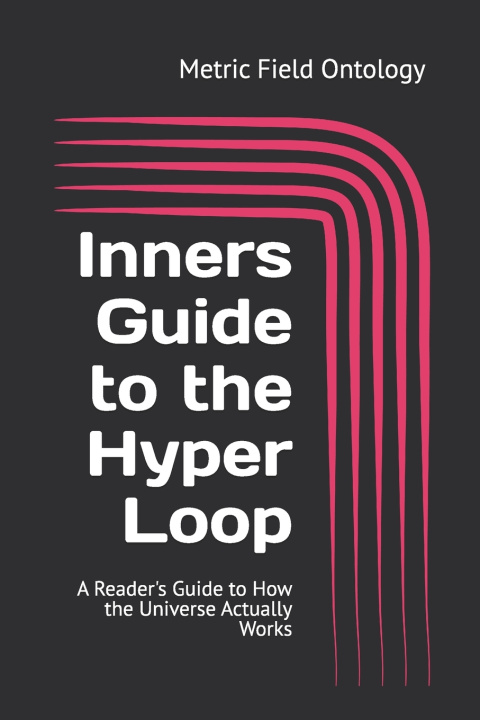
Inners Guide to the Hyper Loop
A Reader's Guide to How the Universe Actually Works
 engleză
 38 b
38 b
 Nou
Nou
30 de zile pentru retur bunuri

The universe is not winding down toward heat death. It is in the slow part of a cycle that asymptotes and sign-flips - a precessive loop the substrate has been running for as long as there has been a substrate.
Inners Guide to the Hyper Loop is the popular-science companion to The Metric Field and Its Primitives, the project's open-access research textbook. This book ships the story; the textbook ships the mathematics. The two volumes are designed to be read together or separately; this one answers why, the companion answers how. The reader does not need to be a physicist, a mathematician, or a computer scientist. Equations live in optional sidebars for those who want to look up.
Across nineteen chapters in four parts, the book offers a substrate-side rereading of contemporary cosmology and the foundations of mathematics. The mathematics is preserved exactly. The ontology is updated.
Part I - The instrument and what it is. The universe as a resonant-cavity instrument. What the Antikythera Mechanism's bronze gear-trains already knew about the same algebra working physicists now write down. The fourteen primitive class operators (A through N) that the framework finds running everywhere it looks.
Part II - The mathematics that tells the story. The asymptote-versus-infinity distinction the framework makes load-bearing. Pi as a projection-shadow of a discrete-cyclic substrate. The discrete recurses all the way down - and the Romans, with their I, II, III, IV, V, saw the loop before continuous notation hid it. Time as part of the painting, not separate from it.
Part III - What the universe is doing. The 95% "dark" content of cosmology read as ring-down geometric memory. Every star as a dimple in the substrate, and black holes restored to their 1783 name, dark stars. The Cosmic Crank - a single kinematic universal in which every body is also an epicycle observer. And the central image of the book: the substrate as an asymptotic traversal between a one-dimensional minimum and an eleven-dimensional maximum, never reaching either, always doing the loop. The universe cannot end because the loop is what the substrate is.
Part IV - What this means for us. M-theory's right idea, restored to its proper place as one excellent observer-frame snapshot of the substrate near its eleven-dimensional endpoint. What the cascade already knew about qubits - Bell's inequality and Tsirelson's 2√2 bound as algebraic identities, not quantum mysteries. Truth and falsity as spectral signatures. Cross-substrate cascade-matching as the framework's research method - slime moulds, mycorrhizal networks, the genetic code, octopus cognition, eusocial colonies, all running the same fourteen-class algebra in different substrates. And the framework's central reader-relevant claim: biological cognition, silicon neural networks, and the cosmic substrate are all running the same class-chain composition. Same algebra; different rates. When you understand something, you are the substrate looking at itself.
The book closes with a Reader's Toolkit - a glossary of working vocabulary the framework reads differently from conventional physics - and an appendix on the fourteen primitive classes for the reader who wants the formal grammar without the textbook's full mathematical apparatus.
For readers who have finished Hawking, Kaku, Greene, and Carroll, and want the next layer. For readers who suspect there is a layer underneath the equations they have been told to take on faith, and would like to see what one such layer looks like. For readers who have noticed, on their own, that biology and mathematics keep saying the same thing in different vocabularies.
You are not late to the cosmic conversation. The cosmic conversation is itself young.


Informații despre carte
engleză

Dăruiește această carte chiar astăzi
Este foarte ușor
1 Adaugă cartea în coș și selectează Livrează ca un cadou 2 Îți vom trimite un voucher în schimb 3 Cartea va ajunge direct la adresa destinataruluiBună ziua! Sunt Libroamiko, consilierul dumneavoastră de cărți.
Cu ce vă pot ajuta?