
 Contact
 Cum să cumpăr

Livrare
Consilier de cumpărături
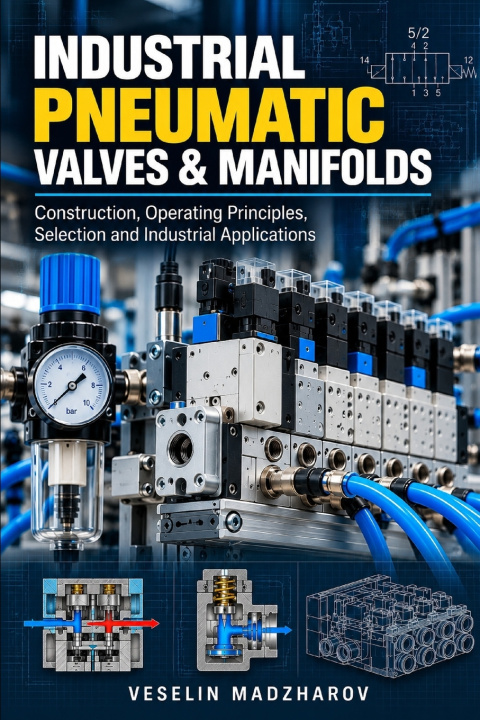
INDUSTRIAL PNEUMATIC VALVES & MANIFOLDS
Construction, Operating Principles, Selection and Industrial Applications
 engleză
 62 b
 Nou
 Livrăm până la Crăciun ▾
În depozitul extern
Expediem în 9-13 zile
Până la 30 de zile pentru returnare

A pneumatic valve can have the correct port size and voltage-and still cause an unreliable machine cycle. The real question is how air moves through the entire system, from the supply and valve passages to the actuator and exhaust.
INDUSTRIAL PNEUMATIC VALVES & MANIFOLDS explains how industrial air-control components are constructed, how they operate, and how to select them for practical machinery applications. The focus is on engineering decisions: required motion, switching behavior, flow capacity, pressure losses, reliability, and the consequences of incorrect component selection.
INSIDE THIS BOOK
Directional control valves: 2/2, 3/2, 4/2, 5/2, and 5/3 functions
Spool and poppet construction, sealing, leakage, and internal flow paths
Valve symbols, ISO-style port numbering, and circuit interpretation
Manual, mechanical, pneumatic, solenoid, and pilot actuation
Monostable, bistable, and center-position valve behavior
Switching dynamics, response time, flow capacity, and pressure drop
Pressure and flow control, cylinder matching, and actuator performance
Valve materials, seals, compressed-air quality, and maintenance considerations
Manifold architecture, shared supply and exhaust paths, and pressure zones
Installation practices, common selection mistakes, and machine-level design reviews
PRACTICAL ENGINEERING KNOWLEDGE
The explanations connect fundamental principles to industrial situations such as packaging and assembly machinery. Illustrative calculations and engineering studies show why a static pressure reading may not describe the pressure available during motion-and why a larger valve or cylinder is not always the solution.
FROM VALVE FUNCTION TO MACHINE BEHAVIOR
A 5/2 symbol tells you how a valve connects ports, but it cannot tell you whether a cylinder will reach its required speed. This book shows how to trace supply and exhaust paths, assess backpressure, distinguish theoretical force from actual operating conditions, and examine what happens when power or pilot pressure is removed.
MANIFOLDS AS COMPLETE PNEUMATIC NETWORKS
Manifold selection goes beyond choosing how many valves fit onto a base. Shared air supplies, common exhaust galleries, pressure zones, simultaneous actuator demand, and tubing restrictions can affect every station connected to the assembly. Learn to evaluate these interactions as part of a complete machine rather than as isolated catalog specifications.
ENGINEERING STUDIES AND DESIGN REVIEWS
Follow realistic, illustrative engineering scenarios involving packaging and assembly equipment, cylinder force, pressure budgets, valve response, and component selection. Practical review questions help distinguish a genuine valve limitation from restrictions elsewhere in the circuit. Technical appendices provide calculation references and a functional specification worksheet for documenting design decisions.
The book also emphasizes the limits of assumptions. A closed-center valve is not automatically a validated load-holding device, and isolating an air supply does not necessarily remove stored pneumatic energy. Safe implementation requires manufacturer data and a machine-specific risk assessment.
WHO THIS BOOK IS FOR
Maintenance technicians, machine builders, mechanical and electrical engineers, industrial automation specialists, PLC technicians, and technical students seeking a structured reference for pneumatic component selection and system analysis.


Informații despre carte
engleză

Dăruiește această carte chiar astăzi
Este foarte ușor
1 Adaugă cartea în coș și selectează Livrează ca un cadou 2 Îți vom trimite un voucher în schimb 3 Cartea va ajunge direct la adresa destinataruluiBună ziua! Sunt Libroamiko, consilierul dumneavoastră de cărți.
Cu ce vă pot ajuta?