
 Contact
 Cum să cumpăr
Livrare
Consilier de cumpărături
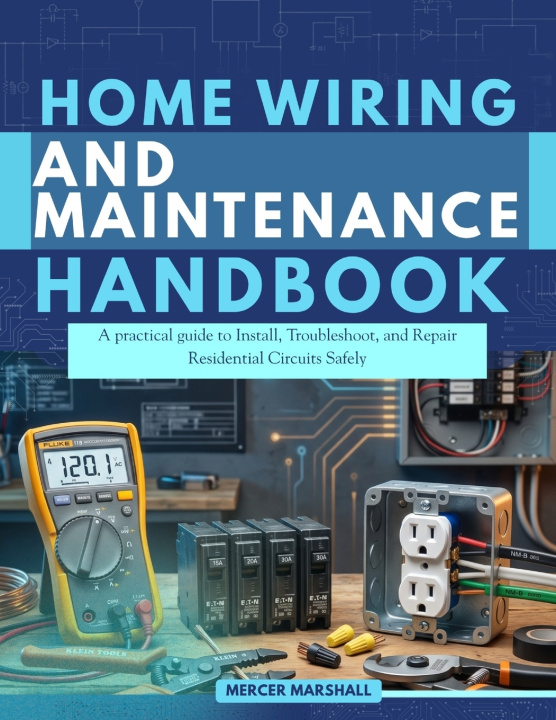
Home Wiring and Maintenance Handbook
A practical guide to Install, Troubleshoot, and Repair Residential Circuits Safely
 engleză
 72 b
72 b
 Nou
Nou
Până la 30 de zile pentru returnare

A loose terminal screw does not look like a hazard. It looks like a terminal screw.
That is what makes residential electrical work unlike any other household trade. A plumbing error announces itself immediately. A carpentry error is visible from across the room. An electrical error can work perfectly for fifteen years and then start a fire inside a wall cavity at two in the morning, and the chain connecting the original mistake to the eventual damage is invisible to everyone involved.
Most books about home wiring answer the question of what to do. Far fewer answer why. A reader who has memorized a diagram can reproduce it in a familiar situation and is left with nothing the moment the situation changes: an unfamiliar panel, an older house, a circuit that behaves in a way no diagram anticipated. Knowing which wire goes where is not the same as knowing what the circuit will do.
This handbook develops the second kind of knowledge. Every requirement is paired with the physical reasoning that produced it, every calculation is worked in full with units carried through each step, and exceptions are stated rather than quietly omitted.
Inside this handbook you will:
- Follow the supply from the utility transformer through the service entrance and panel to the last device on the last branch circuit
- Understand why the neutral and the equipment grounding conductor are joined at exactly one point, and what happens electrically when that rule is broken
- Size conductors for ampacity, temperature, termination limits, and voltage drop, and calculate box fill, branch-circuit loads, and a complete dwelling service by two methods
- Measure voltage, current, resistance, and continuity correctly, and interpret what the instrument is actually reporting
- Apply a systematic method to open circuits, short circuits, ground faults, high-resistance connections, and intermittent faults instead of replacing parts until the symptom goes away
- Understand why a breaker, ground-fault device, or arc-fault device is operating rather than resetting it and hoping
- Recognize where the legal boundary falls between work you may perform and work that must go to a licensed electrician
Three readers are served at once: the homeowner who wants to understand the system in their own house and recognize where a professional becomes necessary; the experienced do-it-yourself practitioner ready to replace accumulated habit with a defensible technical foundation; and the apprentice or newly qualified technician who wants the theory underneath learned procedures assembled in one place.
Open this handbook and begin building the reasoning that lets you approach a panel you have never seen before knowing what is safe, what is required, and where the limits of your own work lie.


Informații despre carte
engleză
Categorii
