
 Contact
 Cum să cumpăr

Livrare
Consilier de cumpărături
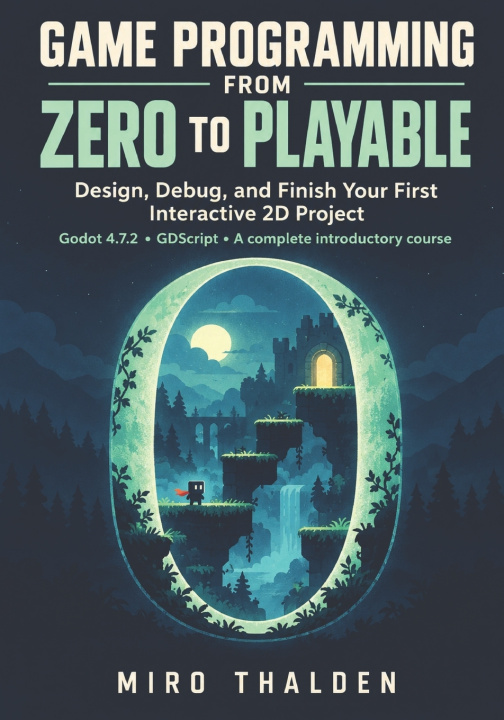
GAME PROGRAMMING FROM ZERO TO PLAYABLE
Design, Debug, and Finish Your First Interactive 2D Project
 engleză
 47 b
 Nou
Până la 30 de zile pentru returnare

You can make a character move. Can you turn that first success into a complete, testable 2D game?
For beginners, the difficult part is often not one line of code. It is making controls, collisions, collectibles, score, health, menus, and level transitions work together-and knowing how to find the fault when they do not. A series of disconnected demonstrations may never answer the most important question: what makes a project truly playable?
This hands-on introductory course walks you from an empty editor project toward a small top-down collection-and-avoidance game. You create a player, collect objects, avoid patrolling hazards, unlock exits, and move through three increasingly demanding rooms. Every new feature has a defined responsibility and a result you can verify before moving on.
Inside, you will learn how to:
- Plan clear gameplay rules, reachable levels, and specific win and loss conditions.
- Understand reusable scenes, scripting fundamentals, vectors, and reliable keyboard movement.
- Implement collisions, pickups, signals, timers, patrols, scoring, health, and level progression.
- Create status displays, title and pause menus, end screens, animation, and sound feedback.
- Use worked examples, checkpoints, practice problems, and project snapshots to test what you build.
- Debug repeatable failures, tune challenge and readability, and check an exported desktop build.
Designed for first-time game creators, students, and hands-on hobbyists with no professional programming background, the course focuses on one manageable 2D desktop project. It does not claim to provide a prebuilt commercial game or cover advanced three-dimensional development, online multiplayer, or console publishing.
Start reading and build toward a first playable project whose behavior you can explain, test, and deliver.


Informații despre carte
engleză

Dăruiește această carte chiar astăzi
Este foarte ușor
1 Adaugă cartea în coș și selectează Livrează ca un cadou 2 Îți vom trimite un voucher în schimb 3 Cartea va ajunge direct la adresa destinataruluiBună ziua! Sunt Libroamiko, consilierul dumneavoastră de cărți.
Cu ce vă pot ajuta?