
 Contact
 Cum să cumpăr

Livrare
Consilier de cumpărături
 engleză
 74 b
 Nou
Până la 30 de zile pentru returnare

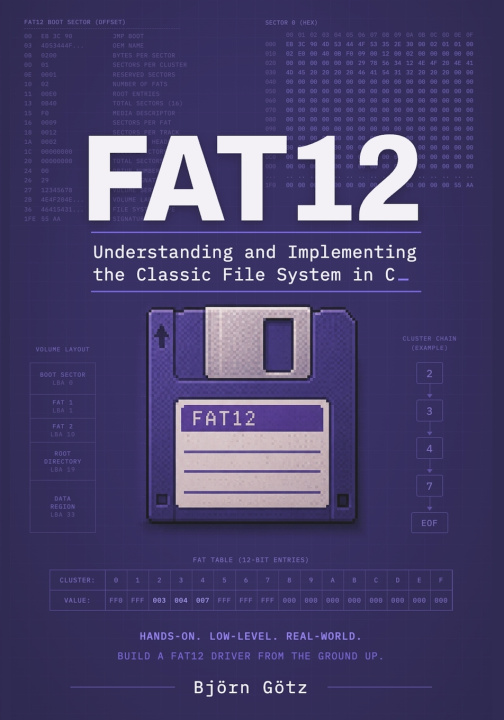
Build FAT12 from scratch, in C, then boot it inside your own kernel.
Your kernel boots and prints to the screen. Now you want it to load files, but every program it could run sits in a filesystem your code can't parse yet. The wiki articles stop once a file can be read, the tutorials switch to assembly halfway through, and the spec gives you the formulas but not how they fit together. This book goes the whole way, from the first sector read to formatting a fresh volume, all in C.
FAT12 is small enough to hexdump end to end and real enough to boot from. Learn it and you already understand most of FAT16 and FAT32, which still sit on every USB stick and on the partition UEFI boots from.
The part most tutorials skip
FAT12's one trap is the 12-bit FAT entry: two entries packed into three bytes, split across a nibble boundary. Get it wrong and nothing crashes. Another file's cluster chain quietly breaks, and you find out much later. This book decodes it with diagrams, a worked hex example, and the code that does it.
What you build
- Mount a volume and decode its boot sector
- List directories and read files of any size, at any depth
- Delete, move, create directories, and write files, with every write ordered so a badly timed crash does as little damage as possible
- Format a new FAT12 volume from nothing
- Run it all as a command-line tool, then boot the same code, unchanged, inside a 32-bit kernel in QEMU
Checked against the real bytes
At every step you hexdump the disk image, trace what the code did, and compare the two. Once you start writing, Linux's own FAT driver reads your volume back. That driver never saw your code. When an AI assistant hands you FAT code, you'll know exactly what the bytes should be.
The appendixes add a real ATA disk driver, so your volume survives a reboot. They also give a first look at decoding long filenames, cover the boot sector fields the main chapters skip, and compare FAT12, FAT16, and FAT32 side by side.
Who it's for
Hobbyist OS developers who know C: pointers, structs, and bitwise operations. You don't need any filesystem experience, and the only assembly is a 27-line boot stub. You don't need a working kernel either. Everything up to the final chapter runs as a command-line tool on your own machine.
This isn't a C tutorial. It covers FAT12 only, and long filenames get an appendix rather than full support.


Informații despre carte
engleză

Dăruiește această carte chiar astăzi
Este foarte ușor
1 Adaugă cartea în coș și selectează Livrează ca un cadou 2 Îți vom trimite un voucher în schimb 3 Cartea va ajunge direct la adresa destinataruluiBună ziua! Sunt Libroamiko, consilierul dumneavoastră de cărți.
Cu ce vă pot ajuta?