
 Contact
 Cum să cumpăr

Livrare
Consilier de cumpărături
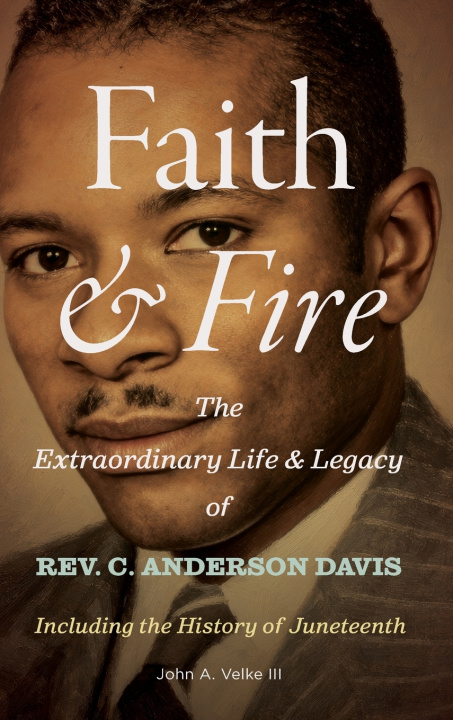
Faith & Fire
 engleză
 71 b
 Curând
 Nou
 Termenul este necunoscut
Până la 30 de zile pentru returnare

Harry E. Johnson, former national president of Alpha Phi Alpha fraternity and former president and CEO of the Martin Luther King Jr. National Memorial Project Foundation, Inc. said of Rev. C. Anderson Davis, "He was a giant, and a giant maker". U.S. Congressman Al Green said, "He had a profound influence on my involvement in human and civil rights as an example of how one person can strive to make a difference." And Hon. Senfronia Thompson, Texas State Congresswoman, described him this way, "He was a brilliant person, always doing something for the Black community." "He left a huge void in the community that has not been filled by anyone."
Relying on thousands of Rev. Davis's personal papers, documents housed at the John F. Kennedy Presidential Library, Governor William Barron's papers at the West Virginia Department of Archives and History, the NAACP Papers in the Library of Congress, personal interviews with his contemporaries, and multiple collections housed in prominent libraries and museums, Faith & Fire describes the influence Rev. Davis had on the civil rights movement, John F. Kennedy's campaign for the White House, his advocacy for recognizing Juneteenth as a holiday, and much more.
Rev. Davis was passionate about Christianity, Education, and Equality, blending these three things in nearly every endeavor. He served as a pastor in the Methodist Church, President of the West Virginia NAACP, and Midwest Vice President for the Alpha Phi Alpha fraternity. He served on President Kennedy's Committee on Equal Employment Opportunities and was appointed by West Virginia Governor William Barron to Chairman of The Emancipation Proclamation Committee to plan a year-long celebration for the 100th anniversary of Abraham Lincoln's January 1, 1863, proclamation ending slavery.
While leading the NAACP in Houston, Texas during the early 1970's Rev. Davis established "Freedom Festivals" celebrated on June 19th each year in recognition of Gen. Granger's Order #3, which was issued on that date to advise Texas that African Americans were now free. In 1975, At the request of Rev. Davis, the Houston City Council adopted a resolution recognizing June 19th as an important date in American History. This was noteworthy because it was the first time any government entity in the United States officially recognized the historical importance of that date. The resolution, and the efforts of Rev. Davis and others, served as the launching pad for Juneteenth to become a State holiday in Texas, and eventually the United States.
Rev. Davis was also a staunch opponent of the death penalty and personally attended many trials where capital punishment could be the likely outcome. My manuscript includes details and the results of several death penalty cases of interest to Rev. Davis. Throughout the book, Rev. Davis's activities are put in context of other events taking place in the struggle to end segregation. For example, Rev. Davis successfully ran a one-man campaign to end segregation at the largest publishing house in the South, six months before Rosa Parks refused to give up her seat on a Montgomery bus.
The impact Rev. C. Anderson Davis had on the civil rights movement, national politics, local politics, and on the hearts and minds of many people, deserves to be recognized and preserved. His papers, serving as the foundation for this work, were stored haphazardly in the attic of a house where he once lived, and are now in possession of The One Thin Dime Museum in Bluefield, WV, where I am the curator.


Informații despre carte
engleză

Dăruiește această carte chiar astăzi
Este foarte ușor
1 Adaugă cartea în coș și selectează Livrează ca un cadou 2 Îți vom trimite un voucher în schimb 3 Cartea va ajunge direct la adresa destinataruluiBună ziua! Sunt Libroamiko, consilierul dumneavoastră de cărți.
Cu ce vă pot ajuta?