
 Contact
 Cum să cumpăr
Livrare
Consilier de cumpărături
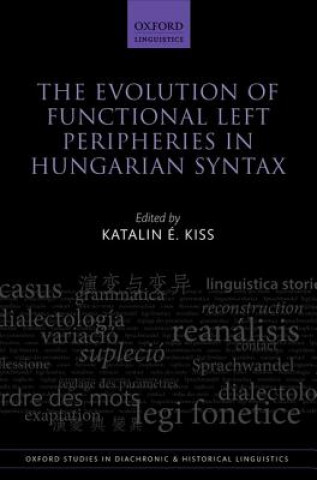
Evolution of Functional Left Peripheries in Hungarian Syntax
 engleză
 510 b
510 b
Până la 30 de zile pentru returnare
Clienții au cumpărat de asemenea




 /
/
 Carte broșată
 121.38
lei
121.38
lei


 /
Carte broșată
44.50
lei
/
Carte broșată
44.50
lei




 /
Carte broșată
136.72
lei
/
Carte broșată
136.72
lei


 /
Carte broșată
1 441.15
lei
/
Carte broșată
1 441.15
lei

 /
Carte broșată
733.96
lei
/
Carte broșată
733.96
lei
 /
Carte broșată
104.34
lei
/
Carte broșată
104.34
lei





This book adopts a generative framework to investigate the diachronic syntax of Hungarian, one of only a handful of non-Indo-European languages with a documented history spanning more than 800 years. Professor E. Kiss and several internationally recognized experts in the field bring together the best in traditional descriptive linguistics and the state-of-the-art in theoretical linguistics to offer an indepth and original survey of some of the most important structural changes in the history of Hungarian. The book specifically focuses on the restructuring of Hungarian syntax from head-final to head-initial, which started in the Proto-Hungarian age. This development led to fundamental structural changes, resulting in the evolution of functional left peripheries on various levels of syntactic structure by the 16th century. Chapters examine a number of related topics, including the emergence of focus, topic, and negative quantifiers, the marking of definiteness, universal quantifiers, and non-finite and finite subordination. The mechanisms of change are those observed in Indo-European languages (reanalysis, grammaticalization, cyclicity), but the paths of change have often been different. The book will be of interest to researchers and graduate students working in historical and diachronic linguistics, as well as all those interested in the mechanisms and theory of linguistic change.


Informații despre carte
engleză
Categorii

Dăruiește această carte chiar astăzi
Este foarte ușor
1 Adaugă cartea în coș și selectează Livrează ca un cadou 2 Îți vom trimite un voucher în schimb 3 Cartea va ajunge direct la adresa destinataruluiAr putea de asemenea, să te intereseze
 /
Carte broșată
297.41
lei
/
Carte broșată
297.41
lei








 /
Copertă tare
690.35
lei
/
Copertă tare
690.35
lei



 /
Carte broșată
175.31
lei
/
Carte broșată
175.31
lei



 /
Carte broșată
76.47
lei
/
Carte broșată
76.47
lei
 /
Copertă tare
149.65
lei
/
Copertă tare
149.65
lei


 /
Carte broșată
177.32
lei
/
Carte broșată
177.32
lei


Bună ziua! Sunt Libroamiko, consilierul dumneavoastră de cărți.
Cu ce vă pot ajuta?