
 Contact
 Cum să cumpăr
Livrare
Consilier de cumpărături
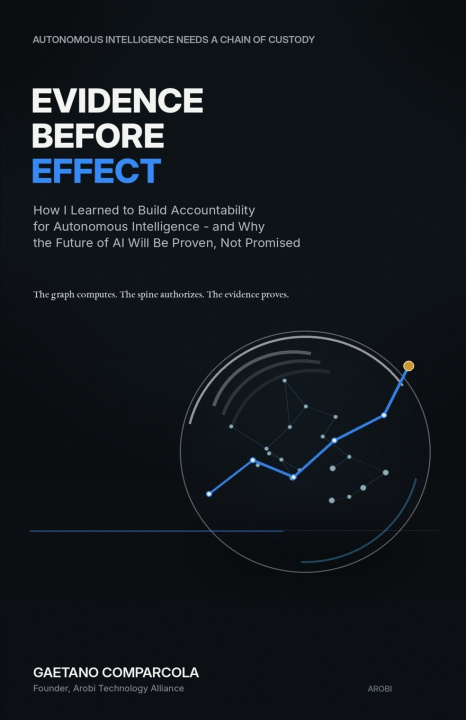
Evidence Before Effect
How I Learned to Build Accountability for Autonomous Intelligence - and Why the Future of AI Will Be Proven, Not Promised
 engleză
 56 b
56 b
 Curând
 Nou
Nou
Până la 30 de zile pentru returnare

Artificial intelligence is crossing a line.
It is moving from answering questions to taking actions.
When software can move money, modify infrastructure, operate machines, call tools, coordinate other agents, and increasingly affect the physical world, intelligence alone is no longer enough.
We need evidence.
In Evidence Before Effect, Gaetano Comparcola tells the story of building Arobi Technology Alliance while pursuing a deceptively difficult question:
How do you make increasingly autonomous intelligence accountable before and after it acts?
Part founder story, part systems-engineering investigation, and part field guide to the emerging infrastructure of autonomous AI, the book follows years of independent study, experimentation, simulation, software architecture, failure analysis, and commercial struggle that led to a simple doctrine:
The graph computes. The spine authorizes. The evidence proves.
Comparcola explores the ideas behind governed execution, identity, authority, invariants, agent memory, cryptographic evidence, independent verification, adversarial testing, predictive risk, robotics assurance, and the growing economic value of decision-and-outcome data.
Along the way, he examines harder questions:
What did an AI actually know when it acted?
Who gave it authority?
What changed between testing and deployment?
Can a system verify itself without creating a circular trust problem?
What happens when memory becomes persistent?
How do we distinguish a valid action from merely a plausible one?
And as autonomous systems generate years of operating evidence, could that data become the foundation for procurement, assurance, risk analysis, and insurance?
Evidence Before Effect is also the story of learning in public: using artificial intelligence as a research partner without outsourcing judgment to it, reading scientific literature outside traditional institutional pathways, testing hypotheses against failure rather than applause, learning the business of deep technology while building it, and discovering that technical credibility ultimately has to survive inspection.
This is not a claim that autonomous intelligence has been solved.
It is an argument that the next era of AI will require something capability alone cannot provide:
accountable execution, verifiable evidence, and institutions capable of deciding when intelligence is allowed to become effect.


Informații despre carte
engleză
