
 Contact
 Cum să cumpăr
Livrare
Consilier de cumpărături
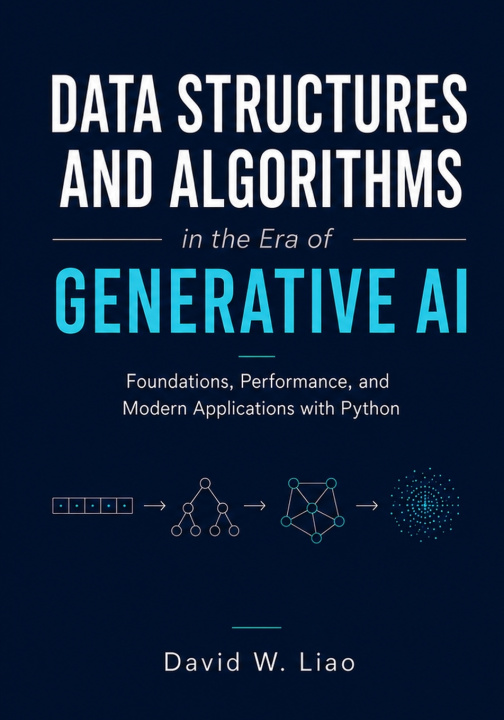
Data Structures and Algorithms in the Era of Generative AI
Foundations, Performance, and Modern Applications with Python
 engleză
 118 b
118 b
 Nou
Nou
Până la 30 de zile pentru returnare

Learn the foundations of Data Structures and Algorithms while discovering how they power modern software and Generative AI systems.
Data Structures and Algorithms in the Era of GenAI presents the essential topics of a traditional undergraduate DSA course through a practical, contemporary lens. Using Python, the book explains not only how common data structures and algorithms work, but also why they matter in applications involving large language models, retrieval systems, intelligent agents, caching, ranking, and data processing.
The book begins with Python and object-oriented programming foundations, then connects Big-O analysis to real-world performance measures such as latency, throughput, memory use, and scalability. It develops the major structures and algorithms step by step, including:
Arrays, lists, strings, and sequence-processing patterns
Linked lists, stacks, queues, and deques
Trees, binary search trees, AVL trees, and Red-Black trees
Heaps and priority queues
Graph representations, traversal, shortest paths, and spanning trees
Hash tables, dictionaries, sets, caches, and memoization
Linear search, binary search, and search variants
Classic sorting algorithms, Timsort, partial sorting, and Top-K selection
Bridge Theory with Modern AI Practice
Generative AI examples are used to clarify the computer science rather than replace it. Readers will see how strings support prompt and response processing, queues manage requests and streaming work, heaps select the best candidates, graphs model workflows and relationships, hash tables support caching and token mappings, and searching and sorting contribute to retrieval and ranking.
Who This Book Is For
Designed for undergraduate students, self-learners, instructors, and industry practitioners, this book requires no prior background in machine learning. Its goal is to help readers move beyond memorizing complexity tables and develop the judgment to choose the right structure for a problem, analyze its tradeoffs, evaluate AI-generated code, and build software that remains efficient as it scales.
Whether you are preparing for a Data Structures course, strengthening your programming foundations, or building modern AI-enabled applications, this book provides the concepts and practical reasoning needed to design better systems.


Informații despre carte
engleză

Dăruiește această carte chiar astăzi
Este foarte ușor
1 Adaugă cartea în coș și selectează Livrează ca un cadou 2 Îți vom trimite un voucher în schimb 3 Cartea va ajunge direct la adresa destinataruluiBună ziua! Sunt Libroamiko, consilierul dumneavoastră de cărți.
Cu ce vă pot ajuta?