
 Contact
 Cum să cumpăr

Livrare
Consilier de cumpărături
Cervical Spine Dysfunctions
Diagnosis with Three-Planar Spring Test and Multimodal Conservative Interventions
 engleză
 79 b
 Curând
 Nou
Până la 30 de zile pentru returnare

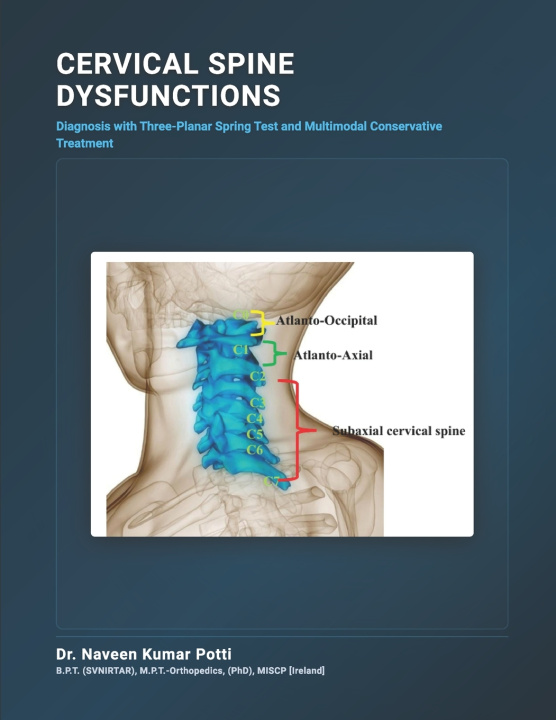
Cervical Spine Dysfunctions
Diagnosis with Three-Plane Spring Test and Multimodal Conservative Treatment
A clinical approach to cervical spine assessment and conservative management
Cervical spine dysfunctions can present with complex combinations of restricted movement, altered segmental mechanics, pain, and functional limitation. Effective clinical assessment requires careful observation of movement, skilled palpation, and a structured approach to interpreting examination findings.
This book presents a clinically oriented framework for assessing cervical spine dysfunctions and planning multimodal conservative treatment. Its central feature is the Three-Planar Articular Glide Spring Test (TPAGST), an author-proposed approach that combines positioning in the sagittal, frontal, and transverse planes with directional translatory spring assessment. The framework aims to help clinicians formulate hypotheses about possible segmental movement and accessory-glide restrictions.
What This Book CoversCervical anatomy and mechanics: Relevant anatomical landmarks, segmental structure, osteokinematics, arthrokinematics, and coupled movements.
Surface anatomy and palpation: Clinical landmarks and palpation concepts to support structured examination.
Proposed pathomechanical relationships: Interpretation of combinations of movement restriction and possible accessory-glide dysfunction.
Three-Planar Articular Glide Spring Test: Principles of three-plane positioning, directional spring assessment, end-feel interpretation, and clinical reasoning.
Upper cervical assessment: Detailed approaches to the occiput-C1 (C0-C1) and C1-C2 regions.
Subaxial cervical assessment: Segment-oriented assessment and proposed glide patterns from C2 to C7.
Multimodal conservative treatment: Descriptions of mobilization procedures, sustained glides, deep transverse friction massage, muscle energy techniques, strengthening, taping, support strategies, and reassessment.
This clinical reference is intended for physiotherapists, manual therapists, musculoskeletal clinicians, postgraduate students, and educators seeking a structured approach to cervical spine examination and conservative management.
The book emphasizes the relationship between observed movement restrictions, proposed segmental mechanical explanations, and treatment planning. It encourages clinicians to integrate examination findings with symptoms, functional limitations, clinical judgment, and appropriate reassessment.
An Author-Proposed Clinical FrameworkTPAGST is presented as a proposed clinical framework rather than an independently validated diagnostic test. The suggested relationships between movement patterns and accessory-glide restrictions require further investigation. Diagnostic accuracy, inter-rater and intra-rater reliability, responsiveness, and treatment effectiveness should be established through appropriately designed research.
By combining cervical anatomy, movement analysis, segment-oriented examination, and multimodal treatment procedures, this book offers clinicians a detailed framework to examine, reason about, and manage cervical spine dysfunctions while recognizing the current limits of the evidence.


Informații despre carte
engleză

Dăruiește această carte chiar astăzi
Este foarte ușor
1 Adaugă cartea în coș și selectează Livrează ca un cadou 2 Îți vom trimite un voucher în schimb 3 Cartea va ajunge direct la adresa destinataruluiBună ziua! Sunt Libroamiko, consilierul dumneavoastră de cărți.
Cu ce vă pot ajuta?