
 Contact
 Cum să cumpăr
Livrare
Consilier de cumpărături
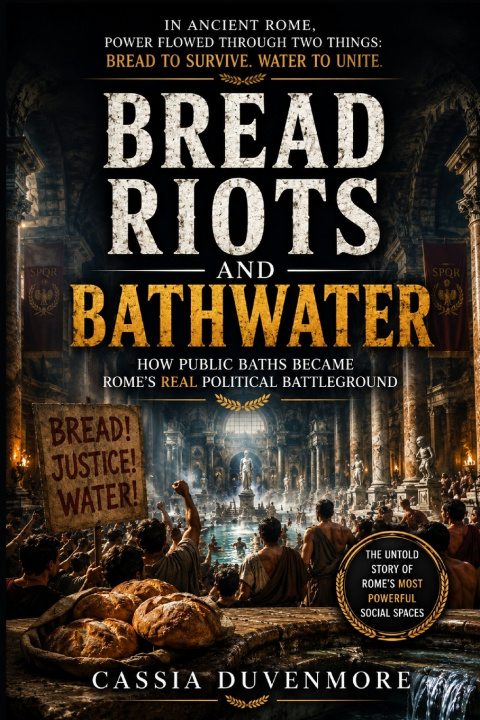
BREAD RIOTS AND BATHWATER
How Public Baths Became Rome's Real Political Battleground
 engleză
 46 b
46 b
 Curând
 Nou
Nou
Până la 30 de zile pentru returnare

Rome did not fall to hunger alone. It nearly fell to a crowd standing in a marble hallway, waiting for hot water.
For six centuries, the emperors of Rome understood something modern history books rarely say out loud: the fate of the world's greatest empire was decided not only in the Senate, but in the steam and gossip of the public bathhouse. This is the story of how a simple daily ritual, washing, became the most dangerous political stage in the ancient world.
Bread Riots and Bathwater pulls back the marble curtain on a Rome you have never seen. You will stand beside Augustus as an enraged mob nearly overwhelms him in the Forum over the price of grain. You will watch a corrupt freedman named Cleander be torn apart by a crowd in the Circus Maximus after gambling with the city's bread supply. You will walk through the colossal, echoing halls of the Baths of Caracalla, built not from generosity but from guilt, by an emperor who had just murdered his own brother. And you will feel the water stop, in the cold spring of 537, when a barbarian army realized that cutting an aqueduct could bring an empire to its knees faster than any siege engine.
This is not a dry academic survey. It is a gripping, character driven narrative that reads like the political thriller it always was, built entirely from real events, real emperors, and real riots that shaped the course of Western civilization. Every figure in these pages actually lived. Every riot actually happened. Every bathhouse still stands, in ruins, as a monument to just how seriously Rome took the politics of comfort.
You will discover why an emperor's popularity could rise or fall with the temperature of a public pool. Why the humble grain dole, the annona, became more valuable to a ruler's survival than any legion. Why bathhouses, of all places, became where senators built alliances, rumors turned into revolutions, and ordinary Romans found the one space in the empire where their anger could not be ignored.
Written with the pace of a thriller and the precision of a historian, Bread Riots and Bathwater is for readers who loved the sweep of SPQR, the drama of The Rise of Rome, and the immersive detail of Pompeii, but who have always wanted to know what happened in the hours ordinary Romans were not being conquerors or senators. It is history from the ground up: from the bathhouse floor to the throne room, and back again.
By the final page, you will never look at a Roman ruin the same way again. Because behind every fallen column and empty pool lies the same unshakable truth this book proves again and again: empires are not only built by armies. They are held together, one bath and one loaf of bread at a time, and when either one fails, so does the emperor who forgot to provide it.
If you have ever wondered how an empire without elections, without a free press, and without a single opinion poll still managed to listen to its people, the answer is waiting for you in the steam.
Read it once, and you will start seeing every crumbling ruin, every ancient headline, every modern crisis of bread and comfort, entirely differently.


Informații despre carte
engleză

Dăruiește această carte chiar astăzi
Este foarte ușor
1 Adaugă cartea în coș și selectează Livrează ca un cadou 2 Îți vom trimite un voucher în schimb 3 Cartea va ajunge direct la adresa destinataruluiBună ziua! Sunt Libroamiko, consilierul dumneavoastră de cărți.
Cu ce vă pot ajuta?