
 Contact
 Cum să cumpăr
Livrare
Consilier de cumpărături
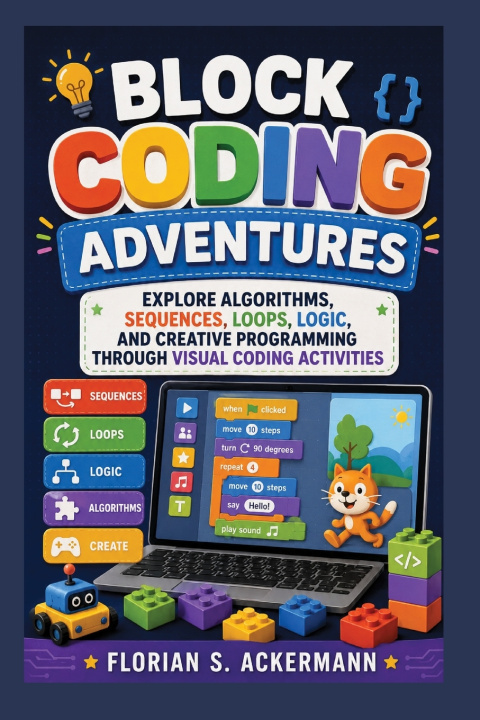
Block Coding Adventures
Explore Algorithms, Sequences, Loops, Logic, and Creative Programming Through Visual Coding Activities
 engleză
 28 b
28 b
 Curând
 Nou
Nou
Până la 30 de zile pentru returnare

Block Coding Adventures
Explore Algorithms, Sequences, Loops, Logic, and Creative Programming Through Visual Coding Activities
How can a few simple instructions become a moving character, a game, an animation, or an interactive project?
Block Coding Adventures introduces young learners to the foundations of programming through visual coding activities. Instead of beginning with complicated programming syntax, the book uses the idea of connecting visual blocks to help readers explore how instructions can be organized to make a computer perform specific tasks.
The book introduces important programming concepts in an accessible way and encourages readers to think carefully about how instructions work together.
Inside the book, young learners explore:
What programming and algorithms mean
How sequences organize instructions
How loops can repeat actions
How logic can guide a program
How visual coding blocks represent instructions
How programs can respond to different conditions
Breaking problems into smaller steps
Finding and correcting simple coding errors
Creating patterns and interactive sequences
Planning simple programming projects
Using creativity to develop coding ideas
Applying computational thinking to everyday problems
Programming begins with instructions. A computer follows those instructions in a particular order, which means that changing the sequence can change the result. Understanding this simple idea provides an important foundation for learning how programs work.
Algorithms provide another important part of programming. An algorithm is a set of steps used to solve a problem or complete a task. By exploring algorithms through visual activities, young readers can begin to understand how complex tasks can be divided into manageable instructions.
Loops introduce the idea of repetition. Instead of writing the same instruction many times, a program can use a repeating structure to perform an action more efficiently. This concept appears throughout programming and is useful for creating patterns, animations, and interactive activities.
Logic helps programs make decisions. Young learners can explore how conditions and instructions can be combined to determine what a program should do in different situations.
The book also introduces the importance of testing and debugging. A program may not always behave as expected on the first attempt. By examining the instructions, identifying problems, and changing individual blocks, readers can learn how programmers improve their programs.
Visual coding provides a way to explore these concepts without requiring readers to begin with traditional text-based programming syntax. The focus remains on understanding how instructions, logic, repetition, and problem-solving work together.
Block Coding Adventures is designed for young learners who are curious about computers, programming, games, animations, and interactive projects. It provides an introduction to computational thinking while giving readers opportunities to experiment with programming ideas.
From simple sequences to loops and logical decisions, the book helps readers explore the basic building blocks of programming through visual activities.
Think step by step. Build your instructions. Test your ideas. Discover how coding works.


Informații despre carte
engleză

Dăruiește această carte chiar astăzi
Este foarte ușor
1 Adaugă cartea în coș și selectează Livrează ca un cadou 2 Îți vom trimite un voucher în schimb 3 Cartea va ajunge direct la adresa destinataruluiBună ziua! Sunt Libroamiko, consilierul dumneavoastră de cărți.
Cu ce vă pot ajuta?