
 Contact
 Cum să cumpăr
Livrare
Consilier de cumpărături
 engleză
 78 b
78 b
30 de zile pentru retur bunuri

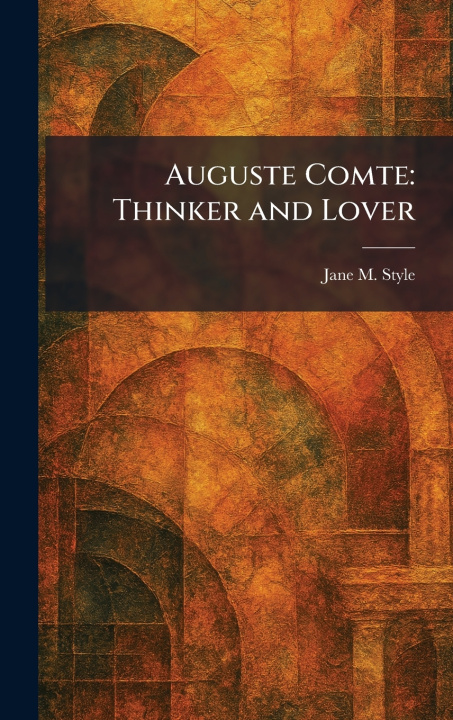
"Auguste Comte: Thinker and Lover" is a compelling biographical study of the French philosopher who founded the school of positivism and the discipline of sociology. Jane M. Style delves into the dual nature of Comte's life, exploring the rigorous intellectual framework of his early work alongside the profound emotional transformation he experienced later in life.
The book provides a detailed look at his philosophical evolution, from the development of the Law of Three Stages to his vision for a scientific approach to social order. Central to this narrative is Comte's relationship with Clotilde de Vaux, an encounter that reshaped his views and led to the creation of the "Religion of Humanity." By examining both his systematic thought and his personal convictions, Style illustrates how Comte's personal life and public theories became inextricably linked.
This work offers valuable insight into the origins of modern social science and the complex personality behind some of the nineteenth century's most influential ideas. It is an essential read for students of philosophy, history, and sociology seeking to understand the man who sought to replace traditional theology with a secular, humanist framework.
This work has been selected by scholars as being culturally important, and is part of the knowledge base of civilization as we know it. This work was reproduced from the original artifact, and remains as true to the original work as possible. Therefore, you may see the original copyright references, library stamps (as most of these works have been housed in our most important libraries around the world), and other notations in the work.
This work is in the public domain in the United States of America, and possibly other nations. Within the United States, you may freely copy and distribute this work, as no entity (individual or corporate) has a copyright on the body of the work.
As a reproduction of a historical artifact, this work may contain missing or blurred pages, poor pictures, errant marks, etc. Scholars believe, and we concur, that this work is important enough to be preserved, reproduced, and made generally available to the public. We appreciate your support of the preservation process, and thank you for being an important part of keeping this knowledge alive and relevant.


Informații despre carte
engleză
