
 Contact
 Cum să cumpăr
Livrare
Consilier de cumpărături
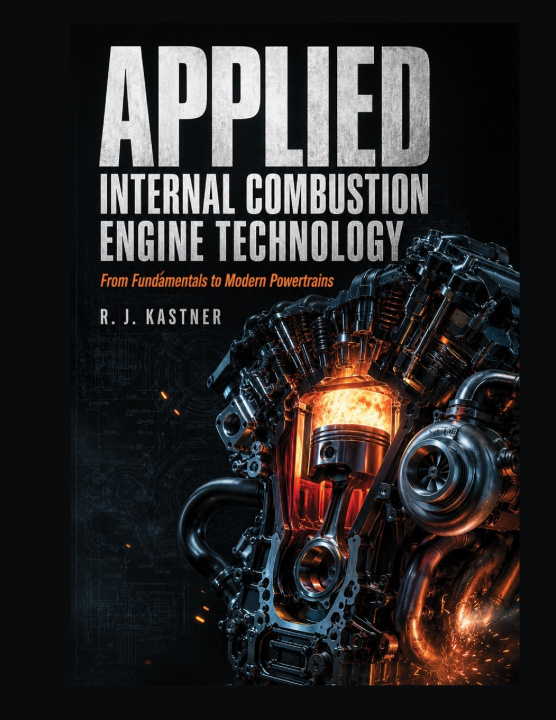
Applied Internal Combustion Engine Technology
From Fundamentals to Modern Powertrains
 engleză
 152 b
152 b
 Nou
Nou
Până la 30 de zile pentru returnare

An engineer who can integrate an Otto-cycle pressure-volume diagram can often still not explain why a modern turbocharged, direct-injected engine needs a particulate filter, a knock sensor, and a hybrid control strategy working together to meet today's performance, efficiency, and emissions targets at the same time.
That gap is a familiar frustration for engineering students and early-career engineers alike. Thermodynamics coursework builds a rigorous foundation in air-standard cycles, but it rarely connects that foundation to the combustion chemistry, mechanical loading, emissions aftertreatment, and electronic control systems that actually govern a production engine. Meanwhile, many design-oriented references assume the cycle analysis is already second nature and move straight to hardware, and readers are often left assembling their understanding from several separate, differently-notated texts: one for cycles, another for combustion, another for mechanical design, another for emissions, another for hybrid systems.
This applied engineering guide closes that gap with a single, internally consistent treatment of the internal combustion engine across sixteen chapters, following the engine's own subsystems in the order a design engineer actually encounters them, from first-principles thermodynamic cycles through combustion physics, fuel chemistry, induction and boosting, mechanical design, electronic control, and hybrid or electrified powertrain integration, closing with a case-studies chapter that applies every prior chapter's methods to real, production-representative engine architectures.
With this book, you will be able to:
- Trace one consistent thermodynamic and mechanical framework across cycle analysis, combustion, fuels, induction, mechanical design, electronics, and hybridization
- Practice calculating indicated and brake mean effective pressure, and volumetric and mechanical efficiency, from realistic engine data
- Work through spark-ignition and compression-ignition combustion fundamentals, including knock, ignition delay, and multiple-injection strategies
- Size fuel injectors, evaluate turbocharger matching, and quantify intercooling benefits using the book's derivation-based approach
- Calculate mechanical loads on valvetrain, piston, connecting-rod, and crankshaft components, including fatigue-life estimation and vibration control
- Evaluate emissions-control trade-offs among charge dilution, catalytic reduction, and particulate-filtration strategies
- Apply the entire framework to three detailed, cross-referenced case studies covering a boosted direct-injection engine, a heavy-duty diesel with layered aftertreatment, and a hybrid-integrated Atkinson-cycle engine
Take the next step toward a single, dependable applied understanding of the internal combustion engine, from fundamentals to modern powertrains, structured as a lasting reference for study and for practice.


Informații despre carte
engleză

Dăruiește această carte chiar astăzi
Este foarte ușor
1 Adaugă cartea în coș și selectează Livrează ca un cadou 2 Îți vom trimite un voucher în schimb 3 Cartea va ajunge direct la adresa destinataruluiBună ziua! Sunt Libroamiko, consilierul dumneavoastră de cărți.
Cu ce vă pot ajuta?