
 Contact
 Cum să cumpăr

Livrare
Consilier de cumpărături
 engleză
 77 b
 Nou
Până la 30 de zile pentru returnare

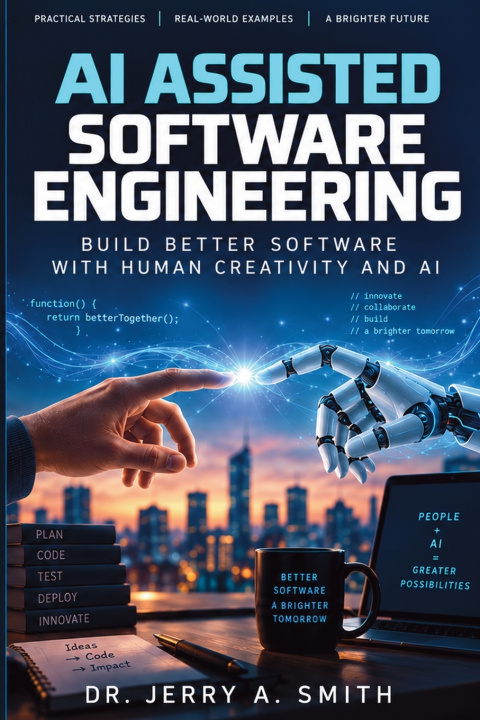
Coding agents now write much of the code. Someone still has to decide what to build, estimate it, manage its risks, review it, control its changes, and know whether it works.
Most courses on AI-assisted development teach prompting, tools and evaluation. Their published topic lists leave out the subjects that turn engineering judgment into numbers a team can act on: estimation, life-cycle planning, risk management, configuration management and reliability. This book argues that those subjects matter more when agents do the construction. They cannot be taught unchanged, though, because every classical method rests on assumptions about who does the work.
AI Assisted Software Engineering teaches each topic of a traditional software engineering course from its classical foundation. Then it tests each one with an assumption audit: name the method, find the assumption it depends on, check that assumption against the evidence, and give a verdict.
- Holds: information hiding and coordination theory matter more when the maintainer is an agent.
- Recalibrate: earned value still works if progress is credited at verified merge, not when code first appears.
- Breaks: cost models built on the size of human-written code need new terms when people mostly review code instead of writing it.
- Inverts: requirements become the primary engineering input, and writing code no longer produces understanding of it.
Every verdict comes with a prediction your project data can test, plus a section on what would make it false. The tools will change before your next project ships. The method for checking what still holds will not.
Inside:
- Eighteen chapters covering life cycles, requirements, size and cost estimation, project management, coordination, risk (including prompt injection), design, construction, reviews, testing and evaluation, configuration management, and the reliability of nondeterministic systems
- An agent-aware cost model with a worked example, compared fairly against COCOMO II
- Four conditions an agent must meet to add real assurance rather than the appearance of it
- A coordination bound and a leak test for teams of agents
- A running case, a small dispatch system, that carries the methods from requirements through maintenance and a handoff to new owners
- Labs, exercises, claim audits, templates, a claim-to-evidence ledger, a glossary and an index
Built for the classroom. The book follows the catalog description of a standard one-semester software engineering course, so it can replace a traditional text without rewriting the syllabus. A semester project runs through it: each student manages a team of agents, keeps an honest work log that becomes the data for estimation and reliability, and inherits a classmate's project halfway through the term. Students are graded on the engineering and the evidence, never on whether their numbers agree with the book. The labs name no tools, so any agent harness works. An Instructor's Guide with a fourteen-week course plan, milestone rubrics and chapter-by-chapter teaching notes is available to adopting instructors.
For upper-division and graduate software engineering students and their instructors, and for engineers and engineering leaders who already work with coding agents and need methods that hold up in production.
About the author: Dr. Jerry A. Smith is a former U.S. Navy nuclear engineer and carrier-based jet pilot. He has led engineering as a chief technology officer and built AI practices inside six global firms, including Cognizant and Capgemini. He founded Verity Vantage Group and wrote The Enterprise Cortex.


Informații despre carte
engleză

Dăruiește această carte chiar astăzi
Este foarte ușor
1 Adaugă cartea în coș și selectează Livrează ca un cadou 2 Îți vom trimite un voucher în schimb 3 Cartea va ajunge direct la adresa destinataruluiBună ziua! Sunt Libroamiko, consilierul dumneavoastră de cărți.
Cu ce vă pot ajuta?