Livrare gratuită pentru comenzile de peste 349 LEI prin Easybox, FAN BOX și Coletăria.

Faceți parte dintr-o comunitate de iubitori de cărți din întreaga lume și beneficiați de o mulțime de avantaje
Creați-vă un cont gratuit
Transport gratuit la punctele de livrare Pick Up peste 349.00 lei
Packeta 15.00 lei
Serviciul de curierat Cargus 28.00 lei
Easybox 20.00 lei
Punct FAN 16.00 lei
Punct DPD 17.00 lei
Curier DPD 25.00 lei
FAN Courier 25.00 lei
 Contact
 Cum să cumpăr
Ajutor
Livrare
Packeta 15.00 lei
Serviciul de curierat Cargus 28.00 lei
Easybox 20.00 lei
Punct FAN 16.00 lei
Punct DPD 17.00 lei
Curier DPD 25.00 lei
FAN Courier 25.00 lei
Transport gratuit la punctele de livrare Pick Up peste 349.00 lei
Consilier de cumpărături
Suntem aici pentru tine!
031 22 95 182
Contul meu
▸
Gol :-(
0
Livrare gratuită pentru comenzile de peste 349 LEI prin Easybox, FAN BOX și Coletăria.
Aeronautics
Why Airplanes Stay in the Sky and How Flight Works: What Do I Already Know About This?
Limba
 engleză
engleză
Carte
Carte broșată
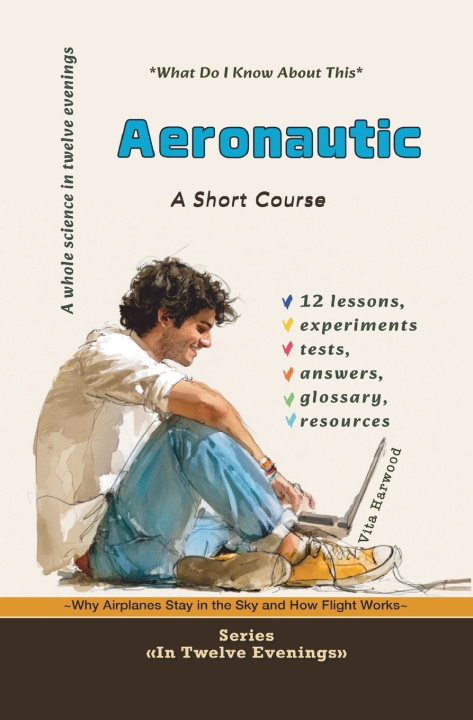
Aeronautics: Why Airplanes Stay in the Sky and How Flight WorksSeries "In Twelve Evenings" Book 4Wha...
Descrierea completă
Codul Libristo: 53678870
?
 41 b
41 b
 Curând
 Nou
Nou
41 b
Curând
Nou
88.33
lei
Așteptăm intrarea în stoc
Ediția 01. 09. 2026
Până la 30 de zile pentru returnare

Aeronautics: Why Airplanes Stay in the Sky and How Flight Works
Series "In Twelve Evenings" Book 4
What Do I Already Know About This?
Vita HarwoodHow can an airplane weighing tens or even hundreds of tons stay in the sky? What really creates lift? Why can a wing stall, why does an airplane bank to turn, and what does the autopilot actually do once a route has been loaded into the computer?
Aeronautics: Why Airplanes Stay in the Sky and How Flight Works invites readers to understand modern aviation in twelve evenings. The book begins with humanity's earliest attempts to fly, then builds the airplane as one connected system: atmosphere and aerodynamics, wings and flight controls, piston and jet engines, structural strength, hydraulics and electricity, navigation, weather, safety, and the future of flight.
Readers discover why the familiar equal-transit-time explanation of lift is wrong, what a stall really is, how fly-by-wire, GNSS, FMS, and inertial navigation work, why an airplane can still glide after engine failure, and how engineers design for turbulence, icing, system failures, and repeated loads.
No college-level math is required. Formulas appear only when they make the physics easier to see. Every lesson includes key terms, a quiz, a simple home experiment, and a Flight Log prompt. The book closes with 120 explained answers, a complete glossary, verified resources, and suggestions for what to read and watch next.
If you have ever looked at an airliner and thought, "How can that possibly work?", this book is your invitation to find out.
Actriță
&
Poliglotă
EWA KASP
pentru
Redă videoclipul


Libristo are cea mai mare selecție de literatură în limbi străine. De aceea îmi cumpăr cărțile de aici.
Informații despre carte
Titlu complet
Aeronautics
Autor
Vita Harwood
Limba
engleză
engleză
Legare
Carte - Carte broșată
Data publicării
2026
Număr pagini
288
EAN
9798170155453
Codul Libristo
53678870
Editura
Independently published
Greutatea
303
Dimensiuni
133 x 203 x 15
