
 Contact
 Cum să cumpăr

Livrare
Consilier de cumpărături
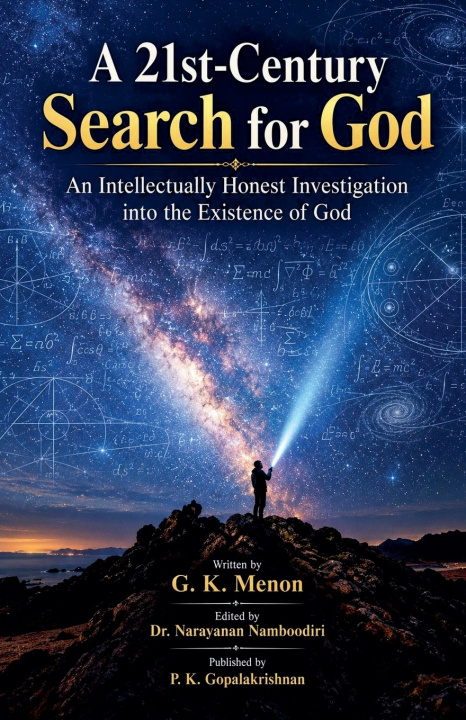
A 21st-Century Search for God
 engleză
 109 b
 Curând
 Nou
Până la 30 de zile pentru returnare

I do not begin by assuming that God exists and then searching for arguments to defend that belief. Nor do I begin by assuming that God does not exist and treating every religious or metaphysical claim as an illusion. Both approaches risk turning investigation into advocacy. When a conclusion is decided in advance, evidence becomes a servant of conviction rather than a means of discovering what is true.
This book takes a different path.
I must be willing to question what I believe, challenge what I find comforting, examine what I find disturbing, and abandon any conclusion that cannot withstand serious scrutiny. If an argument supports a claim, I must examine its premises. If the evidence contradicts an assumption, I must confront the contradiction. If competing explanations remain possible, I must acknowledge them. And if a question cannot be answered with confidence, I must resist the temptation to manufacture certainty merely to bring the investigation to a satisfying end.
Intellectual honesty demands more than an open mind. It demands the discipline to change that mind.
The investigation begins with the foundations of knowledge itself. Can I trust my senses? What does it mean to establish a cause? Does the universe require an explanation beyond itself? What can modern cosmology tell me about the origin of the universe, the nature of time, and the concept of nothingness? Why do mathematical structures describe physical reality with such extraordinary effectiveness? Does the apparent fine-tuning of the universe provide evidence of design, or are other explanations possible?
The inquiry then moves into the mystery of consciousness. I examine the relationship between the brain and subjective experience, the construction of the self, and the unresolved philosophical questions surrounding the nature of awareness. I consider whether physical explanations are sufficient, while refusing to treat the limits of current scientific knowledge as automatic proof of a supernatural reality.
The journey also engages with the Upanishadic ideas of Ātman, Brahman, and ultimate reality. These ancient philosophical traditions are examined alongside contemporary discussions of consciousness and metaphysics, with respect for their depth and a clear distinction between philosophical insight and scientifically established fact.
Finally, I confront the major arguments for God's existence, the different meanings attributed to the word God, the evidential significance of spiritual experiences, and the strengths and limitations of competing positions.
At every stage, one distinction remains essential: an unanswered question is not proof of God; the success of science is not, by itself, proof that no reality exists beyond physical description; and the intensity of a personal experience does not automatically establish the truth of the interpretation attached to it.
The challenge is to apply the same critical standards to every position, including the one I may personally find most persuasive.
The courage to believe is not the only courage. The courage to doubt, to reconsider, to admit uncertainty, and to change one's mind in the presence of better reasons is equally profound.
For readers who value science, philosophy, independent thinking, and the uncompromising pursuit of truth, A 21st-Century Search for God offers an invitation to examine the deepest questions of existence without surrendering either wonder or reason.
The question is ancient. The responsibility to investigate it honestly is timeless.
I begin without demanding a particular answer. I proceed without granting any belief immunity from examination. And I allow the strength of the evidence-not the comfort of certainty-to determine what I can honestly claim to know.


Informații despre carte
engleză

Dăruiește această carte chiar astăzi
Este foarte ușor
1 Adaugă cartea în coș și selectează Livrează ca un cadou 2 Îți vom trimite un voucher în schimb 3 Cartea va ajunge direct la adresa destinataruluiBună ziua! Sunt Libroamiko, consilierul dumneavoastră de cărți.
Cu ce vă pot ajuta?